

Insider and congressional stock trading, tracked
Twelve months of insider and political trading on every company we cover, tagged by chamber and filing date, so you can see who bought what and when they had to tell you.
Last updated October 12, 2026
Smart Money tracks twelve months of net buying and selling by company insiders (Form 4 filings, the form an insider must file after trading their own company's stock) and by members of Congress (STOCK Act filings, the disclosures the law requires of them). You will find it on every ticker page, on its own page, and in the Top 10 table.
Executives know their business. Legislators sit unusually close to policy, procurement and regulation. When either group puts their own money into something, it is worth being able to see it, and most people never do, because the filings are public but scattered.
What we surface
Every disclosure is parsed, dated, matched to a ticker and tagged. On any company you can see who bought, who sold, how much, which chamber a legislator sits in, and how the last twelve months net out. The net counts open-market purchases and sales; stock awards, option exercises and gifts are listed but do not move it. Members of Congress disclose a dollar range, not an exact amount, so the figure we show for a legislator's trade is the middle of the range they reported.
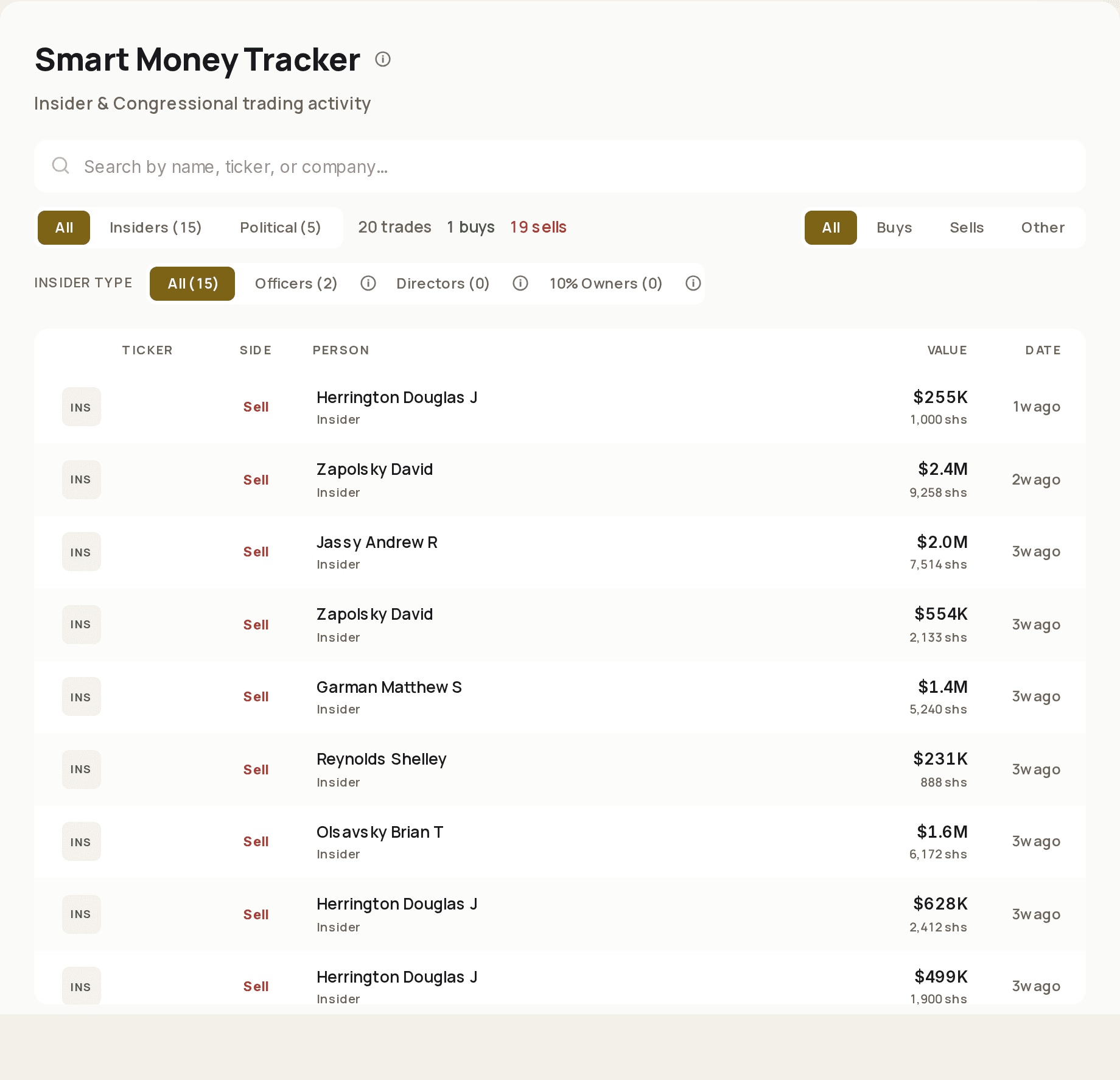
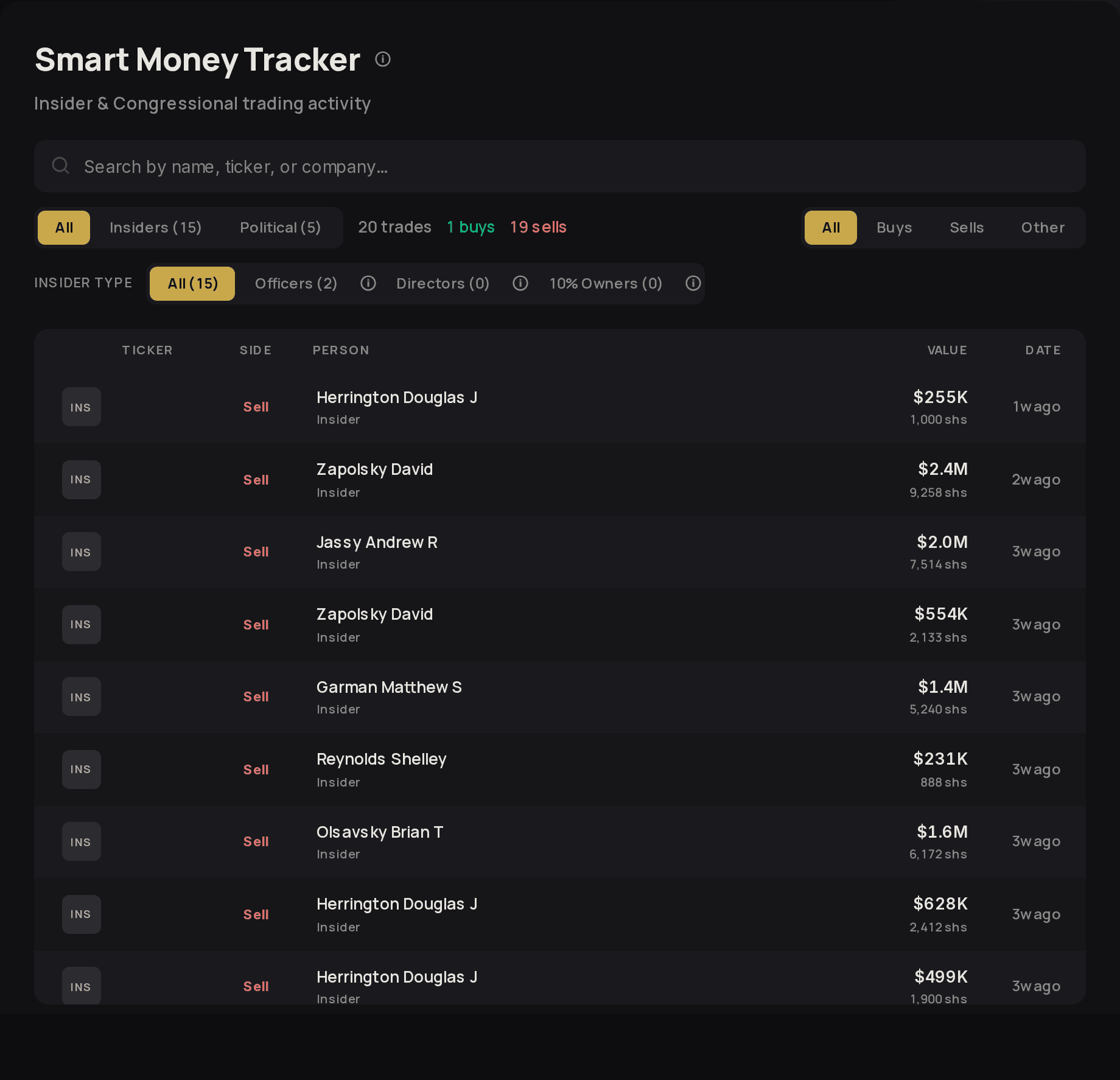
Start with the base rates, because they are the thing that stops a single filing being over-read. Measured on 12 October 2026, across the 977 companies we cover, 750 showed net insider selling over the last twelve months and only 133 showed net buying. Selling is the ordinary state of the world: people sell to buy houses, to pay tax bills and to diversify, and scheduled plans run for years without anyone forming a view. Buying is the rarer event, and rarity is most of what makes it interesting.
On the political side, 420 companies carry at least one disclosed trade by a member of the House in the same window.
Here is what that looks like on one famous name. Between 17 July and 28 September 2026, members of the House filed five purchases and six sales of Microsoft, and one of the purchases became public 31 days after the trade. A famous stock with filings on both sides is the base rate, not a signal.
The case worth a second look is different: several people who sit close to the decisions that will shape a company's next few years, each separately buying the same, less famous name within a few weeks. None of that says anything about margins, return on capital or free cash flow. If it means anything, it is information about the world the company is about to operate in, which would show up later as a contract award, a tariff line, a subsidy or a ruling.
A different lens on a different clock
The rest of our research is built for a five-year holding horizon. This is not. Concentrated, simultaneous buying by politically well-connected filers is worth a look on a horizon of weeks and months. That is a different question from the one the fundamentals answer, so read it beside them.
Three caveats, and they matter.
We are not claiming any of these people trade on illegal information. These are mandatory public filings, made under disclosure law, and that is the whole reason we can show them to you.
We are not claiming the pattern predicts returns. Clusters like this are rare, the disclosure lag is long and uneven, and any backtest we ran on so few cases would tell you more about our filtering choices than about the world. So we publish the filings and let you read them.
And a cluster can be nothing at all. Politicians buy popular stocks for the same reasons everyone else does, and a couple of coincident filings on a giant, popular stock is noise with famous names attached.
Where to find it
On any ticker page, in the Smart Money section, with the underlying filings listed. On the Smart Money page, across all 973 companies we cover, sortable. And in the Top 10 table, next to every company in the current edition.
On the page
Every one of these is visible to you
- Twelve months of net insider buying and selling, per company
- Congressional trades, tagged by chamber and filing date
- The largest institutional holders of each company
- What 14 well-known investors hold, from their 13F filings
- The filing date each disclosure actually became public
Kept internal
Named, so you know what you are not seeing
- How the flows are turned into the pillar reading
- What role that reading plays in the headline number
Common questions
Are Congressional stock trades public?
Yes. Members of Congress are required to disclose trades, and the disclosures are published with a filing date. Returnolio surfaces them per company, tagged by chamber, so they can be read next to everything else about the business rather than as a headline on their own.
Does an insider selling mean something is wrong?
Usually not. People sell shares to buy houses, pay tax bills and diversify, and scheduled selling plans run for years. Net buying across twelve months carries more information than any single transaction.
Why does smart money move in steps?
Disclosures arrive on a filing deadline, not on the day the trade happened, so this data moves in steps rather than continuously. It is read as context alongside the fundamentals, not as a trigger.
About three in four companies show net insider selling over a year. That is normal, and it is why a single filing tells you almost nothing.
Educational and proprietary. This explains what our research does, not the exact formula behind it, and it is not personalised investment advice. See the full disclaimer.
Was this page helpful?