

Is R&D an expense or an investment?
Accounting rules expense research the year it is spent. Economically it is an investment that pays off for years. What changes when you book it as one, shown on Meta, Microsoft, Nvidia and Adobe.
Last updated October 8, 2026
Short answer: an investment, booked as an expense. Accounting rules make a company subtract every dollar of research and development (R&D) in the year it spends it. Economically, most of that money buys something that keeps paying for years: a drug, a chip design, a piece of software. Treating it as a cost distorts two numbers at once, and the second distortion is the one most people miss.
Why accounting calls it an expense
The rule exists for a defensible reason. Nobody knows, the year the money is spent, which research projects will pay off. Writing it all off at once is the cautious choice, and accountants are paid to be cautious.
The trouble is what that does to the picture. Think of someone paying for a university degree. If they wrote the whole cost off in the year they paid it, that year would look like a disaster, and every year after it they would seem to earn a salary from nothing. Neither is true. The degree is an asset that pays back over a career, and it also cost real money that could have been doing something else.
What changes when you book it as an investment
Booking research as an asset means two adjustments, and they pull in opposite directions.
Profit goes up. This year's research spending comes off the cost line, and only a slice of past research is charged instead, spread over the years it keeps paying off. A company that is ramping up its research no longer looks less profitable for doing so.
Capital goes up too. The research becomes capital on the balance sheet, just like a factory. And capital is not free. If you charge every business for the capital it uses, as economic profit does, the research now has to earn its cost of capital like everything else.
Which effect wins depends on the company. A young business whose research budget is growing fast mostly gains: its profit was the most understated. A large business sitting on years of accumulated research mostly loses: the hidden capital was the bigger flattery.
Four big research spenders, side by side
Here is economic profit for four large research spenders in our universe, computed both ways. "Research expensed" is economic profit on the reported figures. "Research as an asset" is RTEP, our measure, which books research as an investment.
| Company, fiscal year | Net income | R&D spent in the year | Research asset on our books | Economic profit, research expensed | RTEP, research as an asset |
|---|---|---|---|---|---|
| Microsoft, year to 30 Jun 2026 | $133.7bn | $35.6bn | $95.0bn | $55.7bn | $50.8bn |
| Nvidia, year to 25 Jan 2026 | $120.1bn | $18.5bn | $38.0bn | $76.2bn | $77.5bn |
| Meta Platforms, 2025 | $60.5bn | $57.4bn | $134.6bn | $18.9bn | $17.1bn |
| Adobe, year to 28 Nov 2025 | $7.1bn | $4.3bn | $11.2bn | $5.3bn | $4.9bn |
Source: Returnolio company financials, read 9 October 2026.
All four create plenty of value once their research is charged for, and the two adjustments pull them in different directions. Microsoft, Meta and Adobe carry decades of research on our books, and charging rent on all of it costs more than adding this year's spending back to profit. Nvidia goes the other way: its spending is growing fast and its research asset is small next to what it earns, so counting research as an investment raises its economic profit.
Meta moves the most.
Meta: the same profit, half the result
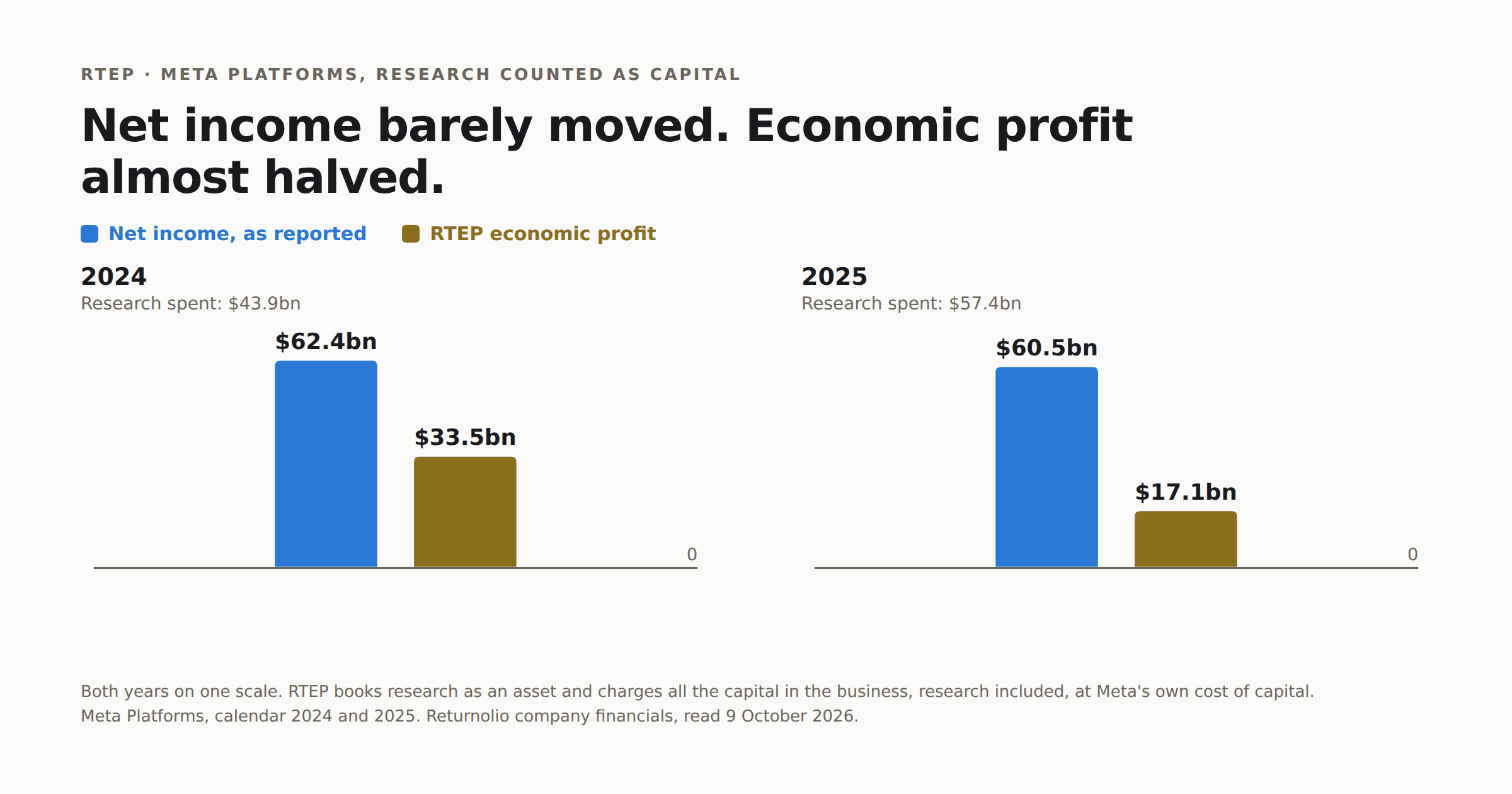
Meta reported $62.4bn of net income in 2024 and $60.5bn in 2025. On the income statement, a quiet year.
Underneath, Meta spent $57.4bn on research in 2025, up from $43.9bn. We add that spending back to profit and charge only a slice of past research instead, so profit is not punished for the extra building. But the research asset on our books grew from $109.4bn to $134.6bn, and all the capital tied up in the business, research included, went from $303bn to $407bn in one year. Charged for that capital, RTEP went from $33.5bn to $17.1bn.
That is not a verdict on Meta's research. It is a measure of how much the research now has to earn. Expensing hides that question; booking research as an asset puts it on the table every year.
Where to see it
On Returnolio, every company page shows RTEP year by year, with the research asset we book and what it does to reported profitability. How the measure works end to end, with Xcel Energy and Costco as the other two worked examples, is on RTEP: economic profit, and why accounting profit lies. For the plain difference between economic profit and net income, start with economic profit vs net income.
Common questions
Is R&D an expense or an investment?
Accounting treats it as an expense in the year it is spent. Economically most of it is an investment, because it buys products and know-how that pay off for years. Booking it as an asset gives a truer picture of both profit and the capital a company uses.
What does capitalising R&D mean?
Recording research spending as an asset on the balance sheet instead of a cost in the year it is spent, then spreading that cost over the years the research keeps paying off. Accountants call the spreading amortisation.
Does capitalising R&D make a company look more profitable?
It raises profit in heavy research years, but it also adds the research to the capital the business uses. Once that capital is charged for, economic profit can go down. For Meta in 2025 it went from $18.9bn with research expensed to $17.1bn with research as an asset.
Meta's net income barely moved in 2025. Count its research as the investment it is, and its economic profit almost halved, from $33.5bn to $17.1bn.
Educational and proprietary. This explains what our research does, not the exact formula behind it, and it is not personalised investment advice. See the full disclaimer.
Was this page helpful?