

Economic profit vs net income: how a profitable company loses value
Net income charges a company for its debt and nothing for its shareholders' money. Economic profit charges for both. Xcel Energy shows how a company can report a profit every year and still fall short of what its capital costs.
Last updated October 8, 2026
Net income is the profit at the bottom of the income statement. Economic profit is what is left after the business has also paid for the shareholders' money. You may also meet it as economic value added (EVA) or residual income. The first can be healthy while the second is negative, and when that lasts, the owners are getting poorer while the company reports a profit.
That sounds like an accounting technicality. It is the difference between a business that makes its owners richer and one that just keeps them busy.
What net income leaves out
A company is paid for by two groups of people. Lenders put in debt and send a bill for interest. Shareholders put in equity and send no bill at all. They just expect a return, and if the company cannot deliver it, they would have been better off somewhere else.
The income statement only sees the bill. Interest is subtracted on the way to net income; the shareholders' expected return is not. So net income answers "did the company earn more than it paid out?" and stays silent on "did it earn enough to justify the money tied up in it?"
Here is the same thing in a kitchen. You bake bread to sell, and after flour, power and the loan on the oven, you clear $200 a week. Good. But you also put $40,000 of your own savings into the bakery, and those savings could have been earning you something without a 4 a.m. alarm. Net income says $200. Economic profit asks whether $200 a week is a fair return on $40,000 of your money, and the honest answer might be no.
Economic profit adds the missing charge
Economic profit starts from what the business earns from its operations after tax. Then it subtracts a charge for all the capital in the business, debt and equity together, at the business's cost of capital: what that money actually costs, in interest and in the return shareholders expect for the risk.
Three things can happen:
- The business earns more than its capital costs. Economic profit is positive, and growth that earns the same return makes the owners richer.
- It earns about the same. The business is treading water. Growth adds size, not value.
- It earns less. Economic profit is negative, and every new dollar put into the business at the same return makes the shortfall bigger, even as net income rises.
That last case is the dangerous one, because nothing in the income statement flags it.
Xcel Energy, 2016 to 2025
Xcel Energy is a regulated electricity utility, and it reported positive net income in every year from 2016 to 2025. Here is its return on invested capital (what it earns from operations, after tax, on all the money lenders and shareholders have put in) against its own cost of capital over the same years.
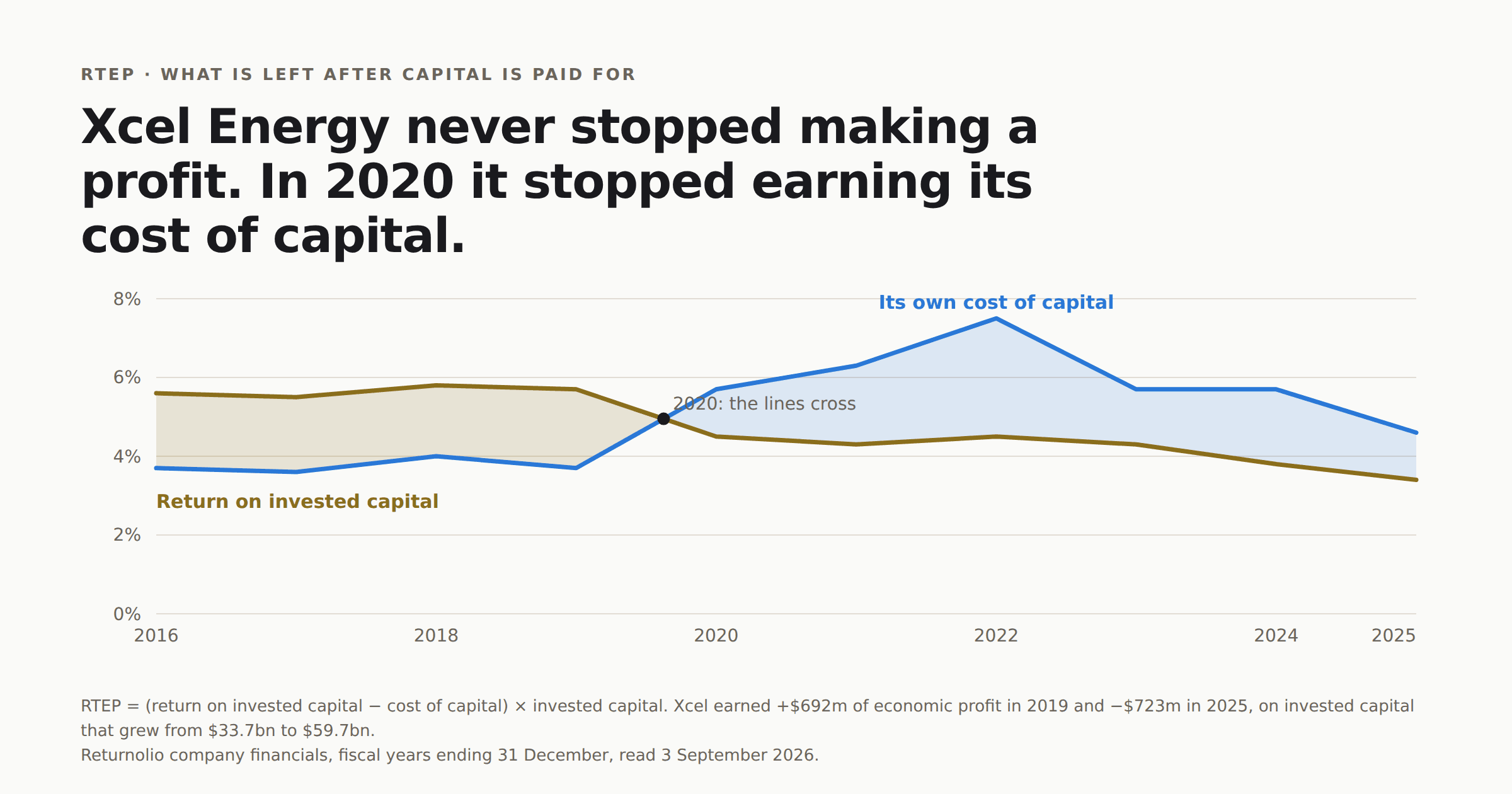
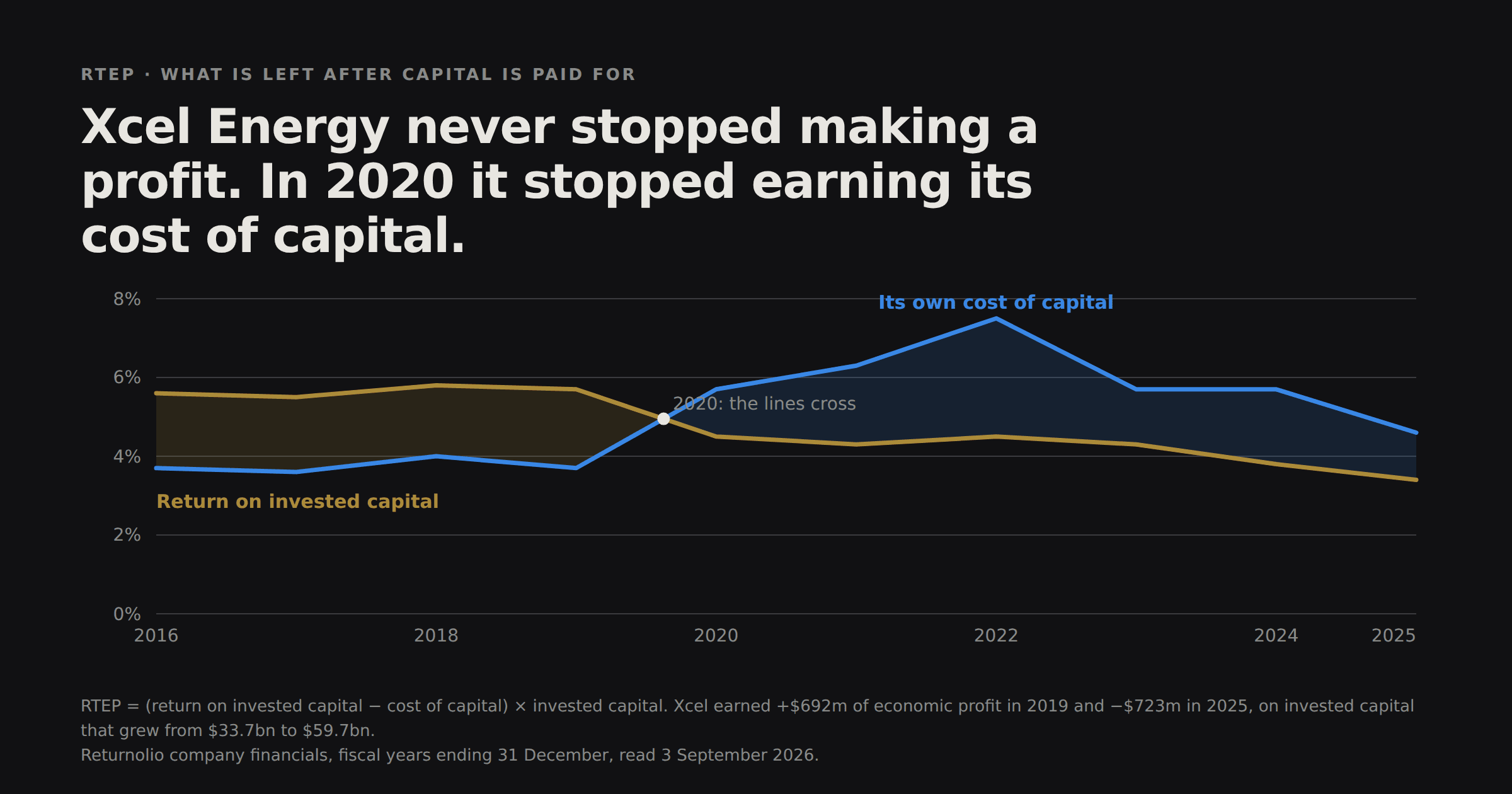
Through 2019, Xcel earned about 5.7% on its capital while that capital cost it about 3.7%. That two-point gap, across the whole business, was $692m of economic profit in 2019.
Then Xcel's cost of capital rose and its return on capital fell, and the two lines crossed in 2020. By 2022, capital cost 7.5% against a 4.5% return, and the business was falling about $1.27bn a year short of what its capital cost.
In 2025, Xcel reported $2.0bn of net income. Its capital had grown to $59.7bn. It earned 3.4% on it, and the capital cost 4.6%. The shortfall:
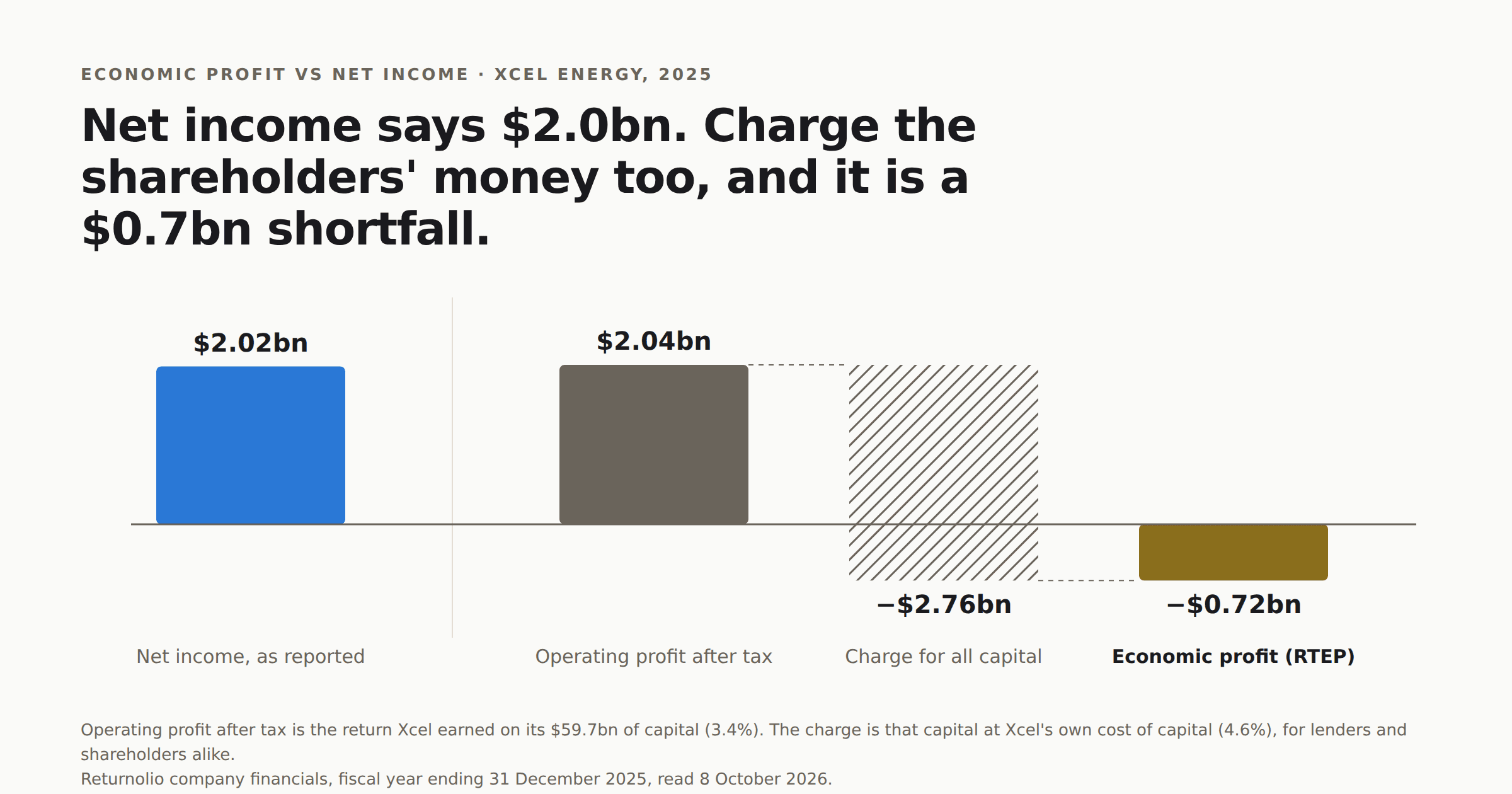
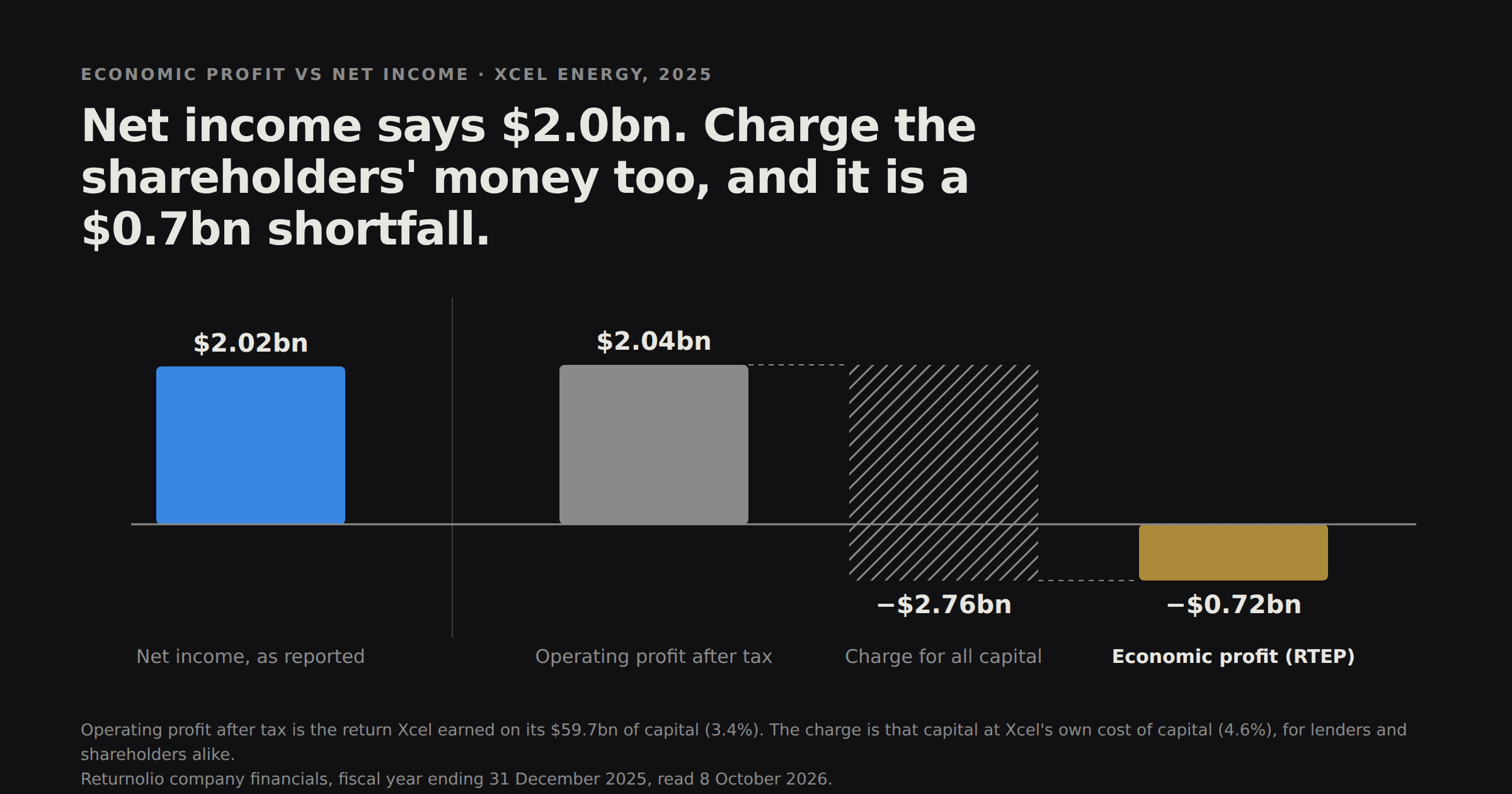
The income statement looks fine. The gap opens only when the shareholders' money is charged for too.
Why a utility, and why it matters
A regulated utility is close to the cleanest case there is. Its regulator largely decides the return it may earn, so when its cost of capital rises, the return cannot simply rise with it. Economic profit goes negative while the reported profit hardly moves.
Most companies are messier. But the question is the same for all of them, and you can ask it of any business you own: what does it earn on its capital, and what does that capital cost? If the first number sits below the second for years, a rising net income is not good news. It is the same shortfall, getting bigger.
How we use this
On Returnolio, economic profit is a measure of its own, called RTEP. Every company page charts its RTEP margin year by year against its industry, and shows the latest return on capital beside the cost of capital we charge. Our version also treats research and development as an investment rather than a cost. The full method, with Costco as a second worked example, is on RTEP: economic profit, and why accounting profit lies.
Common questions
Is economic profit the same as accounting profit?
No. Accounting profit, or net income, subtracts interest on debt but nothing for the shareholders' money. Economic profit subtracts a charge for all the capital in the business, at what that capital costs. A company can show a healthy accounting profit and a negative economic profit at the same time.
Can a company have positive net income and negative economic profit?
Yes. Xcel Energy reported $2.0bn of net income in 2025 and minus $723m of economic profit, because it earned 3.4% on $59.7bn of capital that cost it 4.6%.
Why does economic profit matter to an investor?
Because it says whether growth makes the owners richer. When a business earns more than its capital costs, every reinvested dollar that earns the same return adds value. When it earns less, every reinvested dollar at that return makes the shortfall bigger, even while net income rises.
Net income sends the lenders a bill and forgets the shareholders. Economic profit sends both. Xcel Energy has reported a profit every year since 2016, and has earned less than its capital costs every year since 2020.
Educational and proprietary. This explains what our research does, not the exact formula behind it, and it is not personalised investment advice. See the full disclaimer.
Was this page helpful?