

RTEP: economic profit, and why accounting profit lies
A company can report a profit every year and still fall short of what its capital costs. RTEP charges every business for the capital it uses, at its own cost, and treats research as an investment. Two real companies show the difference.
Last updated October 8, 2026
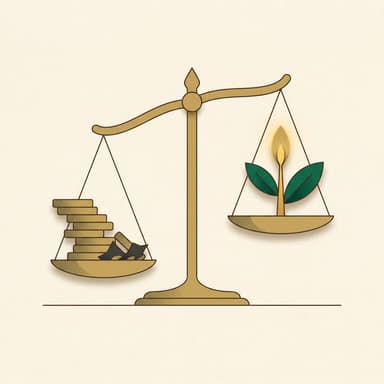

A company reports a profit. The share price is fine, the dividend is paid, the headline says "earnings up". Then, ten years later, the shareholders are no richer than if they had left the money in a savings account.
That gap has a name: economic profit. It is what a business earns after it has paid for every dollar of capital it uses, at what that capital actually costs. You may also meet it as economic value added (EVA) or residual income. Accounting profit skips that last charge. RTEP, Returnolio True Economic Profit, is our version of the measure, and the whole Returnolio model grew around it.
Profit that hides its cost
Say you rent out a flat and it clears $300 a month after the mortgage and the repairs. That feels like profit. Now count the $60,000 deposit you put in. Left in an index fund, it might have earned you more than $300 a month, with no tenant phoning at midnight. Count that, and the profitable flat is a losing one.
Accounting does the first half of that sum and stops. The income statement charges a company for its debt, because interest is a bill someone sends. It charges nothing for the shareholders' money, because nobody sends a bill for that. But shareholders expect a return too, and if the business cannot pay it, their money would have done better somewhere else.
Economic profit adds the missing line. Take what the business earns from its operations, then subtract a charge for all the capital tied up in it, lenders' and owners' alike. What is left, if anything, is value the business actually created. A negative number means the business used money worth more than it made with it, whatever the bottom line of the income statement says.
There is a longer walk through the difference, on one company over ten years, in economic profit vs net income.
The rent on money
The charge for capital is the cost of capital: what the money a business uses actually costs it, in interest to its lenders and in the return its shareholders expect for the risk they carry.
Think of it as rent on money. A steady business with a regulator setting its prices borrows cheaply and its shareholders accept a modest return, so its rent is low. A business whose profits swing with every cycle pays more on both counts, so its rent is high. The same 9% return can be a good result for the first and a poor one for the second.
So we never use one house rate. Every company gets its own cost of capital, built from its own debt, its own equity and its own risk, and the rate is shown on its page in the app. Earning 9% on capital that costs 11% destroys value, however good the headline looks, and RTEP says so.
Research is an investment
US accounting rules (GAAP) make a company expense research and development (R&D) in the year it spends the money, as if a new drug or a new chip were the electricity bill. Picture someone writing off a university degree in the year they paid for it: that year's income looks dreadful, and every year after it they seem to earn a salary out of nothing. Both pictures are wrong.
We book research as what it is, an asset, and spread its cost over the years it keeps paying off. That is what accountants call capitalising and amortising it. It cuts in two directions, and both matter:
- Profit stops being punished for building. A company that doubles its research budget no longer looks less profitable for it that year.
- The research now has to earn its cost of capital. Years of research become capital on our books, and that capital is charged rent like a factory or a data centre. A company that spends heavily on research and earns little from it can no longer hide behind a small balance sheet.
A screen built on reported figures does neither. RTEP does both.
What that does to four of the biggest research spenders, Meta, Microsoft, Nvidia and Adobe, is on is R&D an expense or an investment?.
Two companies, two answers
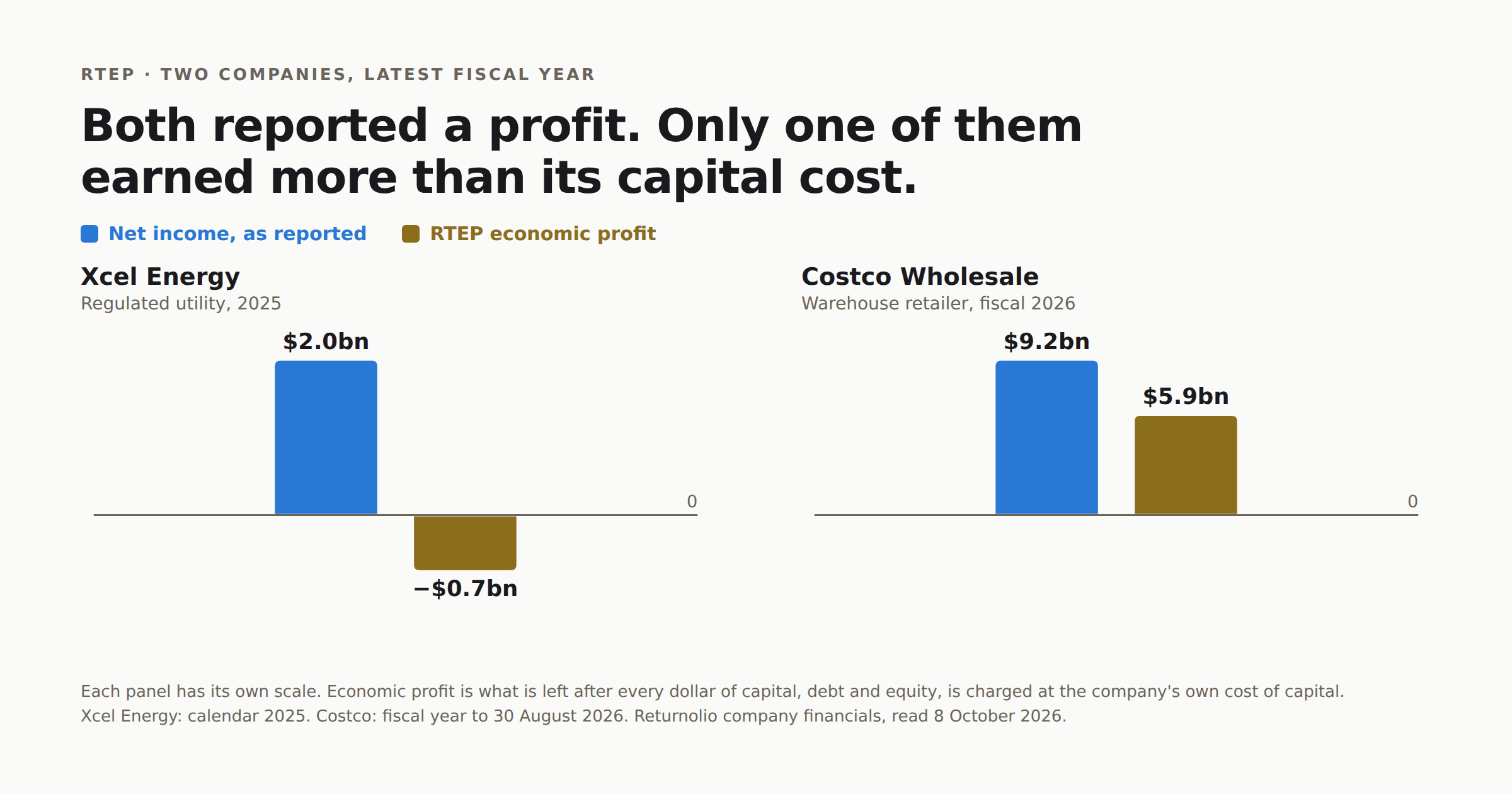
Here is what that looks like on real businesses. Both reported a profit in their latest fiscal year. Their economic profit points in opposite directions.
Xcel Energy: a profit every year, short of its cost of capital since 2020
Xcel Energy is a regulated electricity utility. In 2025 it reported $2.0bn of net income. Its return on the $59.7bn of capital it uses was 3.4%, and that capital cost it 4.6%. The gap, across all that capital, came to minus $723m of economic profit.
It was not always so. In 2019 Xcel earned about 5.7% on capital that cost it about 3.7%, and created $692m of economic profit. Then the cost of capital rose, the return fell, and the two lines crossed in 2020.
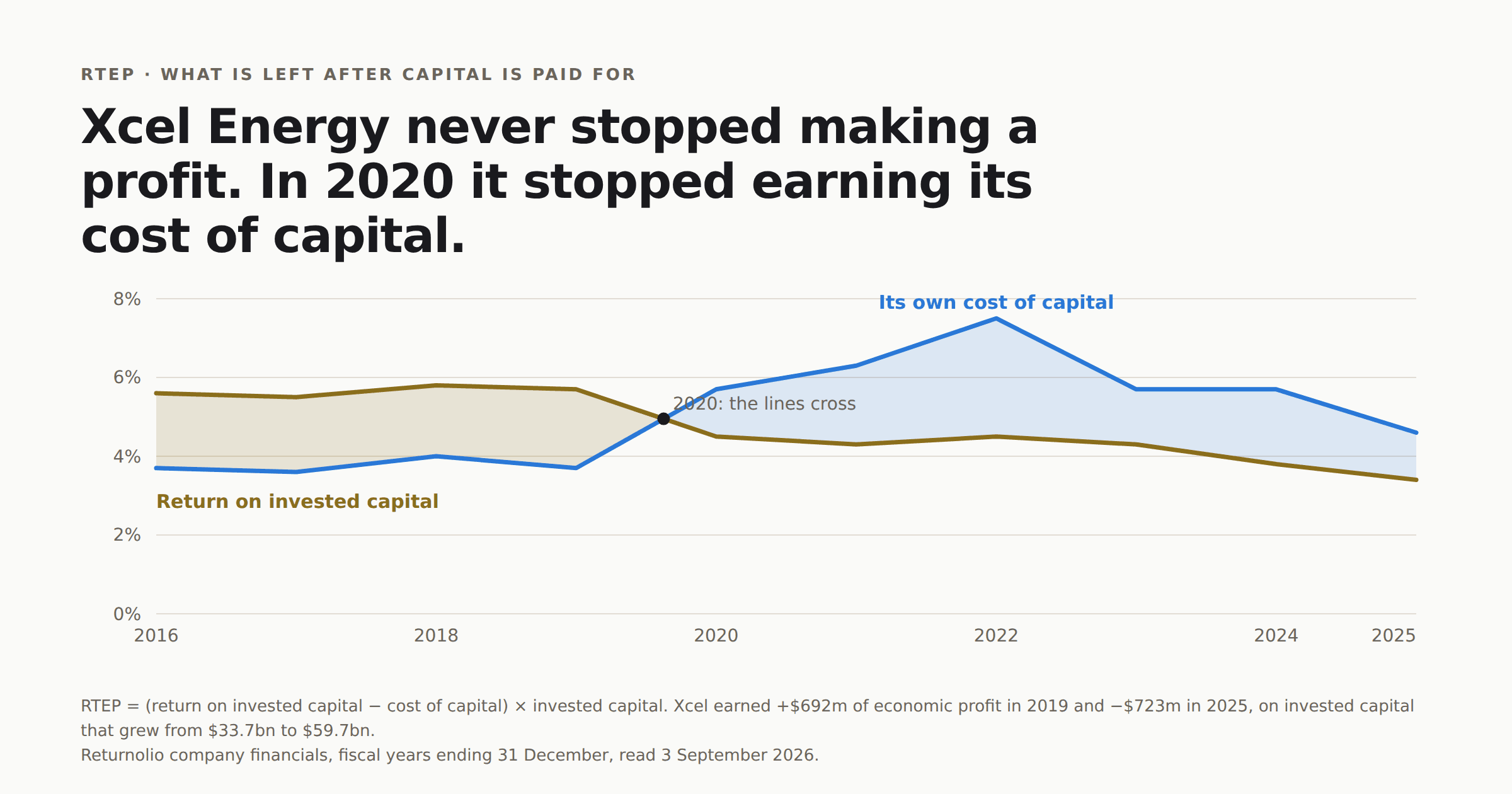
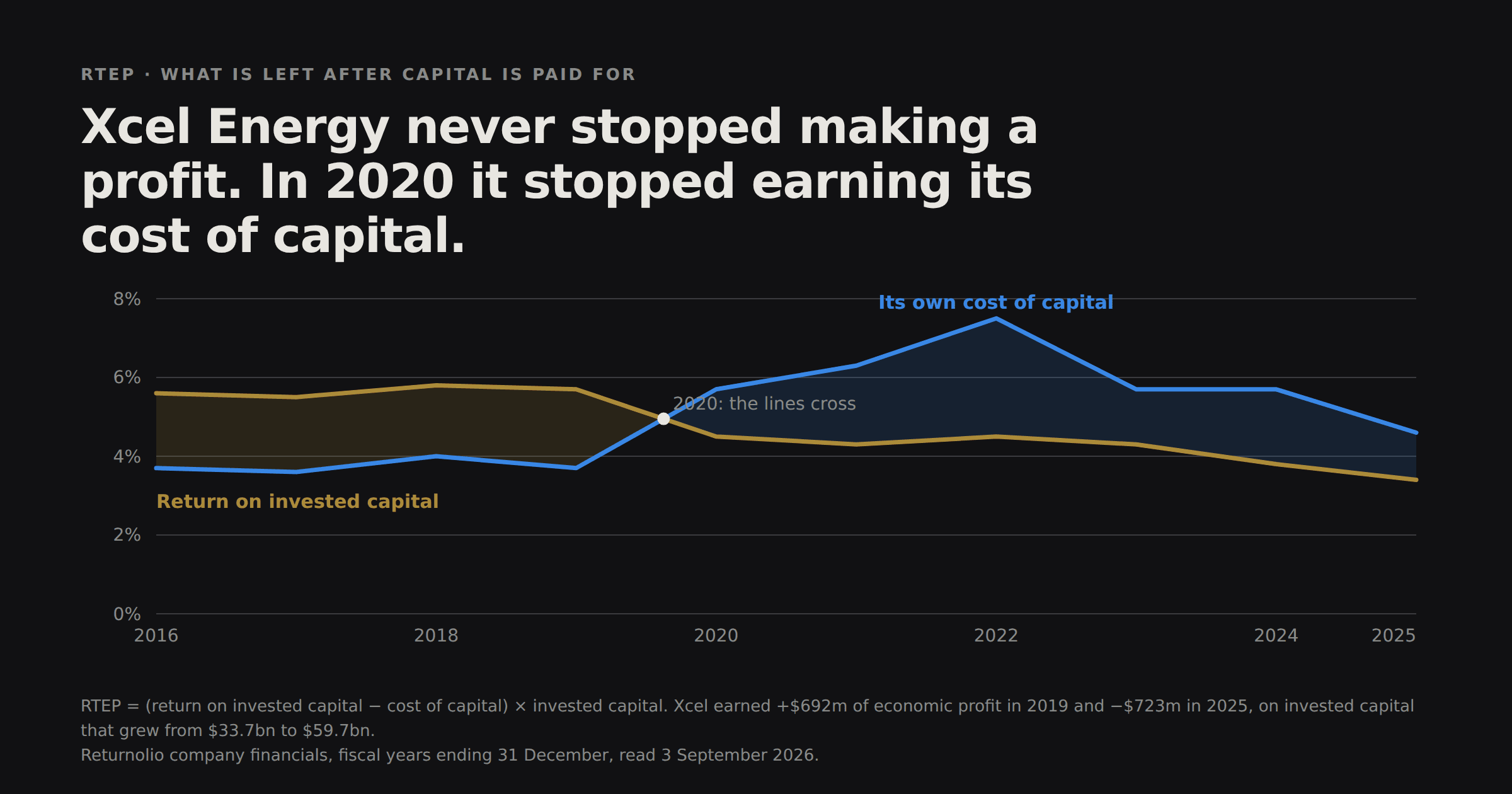
None of this was hidden. Both lines are built from figures in the annual reports. They are simply never printed next to each other.
Costco: a thin margin, a lot of value
Costco Wholesale is famous for selling cheap. In the fiscal year to 30 August 2026 its net income was $9.2bn on $297.2bn of sales (Costco's fiscal 2026 results, read 8 October 2026). Read it by margin and it looks like a modest business.
Read it by economic profit and the picture turns over. On $9.2bn of net income Costco made $5.9bn of economic profit. It earned 25.2% on $34.9bn of capital that cost it 8.2%. Its economic profit has risen two years running: $3.4bn in fiscal 2024, $4.5bn in 2025, $5.9bn in 2026. A thin margin on a lot of sales, from very little capital, is a fine way to create value.
Where RTEP sits in Returnolio
On every company page in the app, the RTEP margin (economic profit as a share of sales) is charted year by year against the industry median, and the latest return on capital is shown beside the cost of capital we charge. RTEP also feeds the Economic Profit pillar of the Returnolio score, next to quality, value, momentum and smart money.
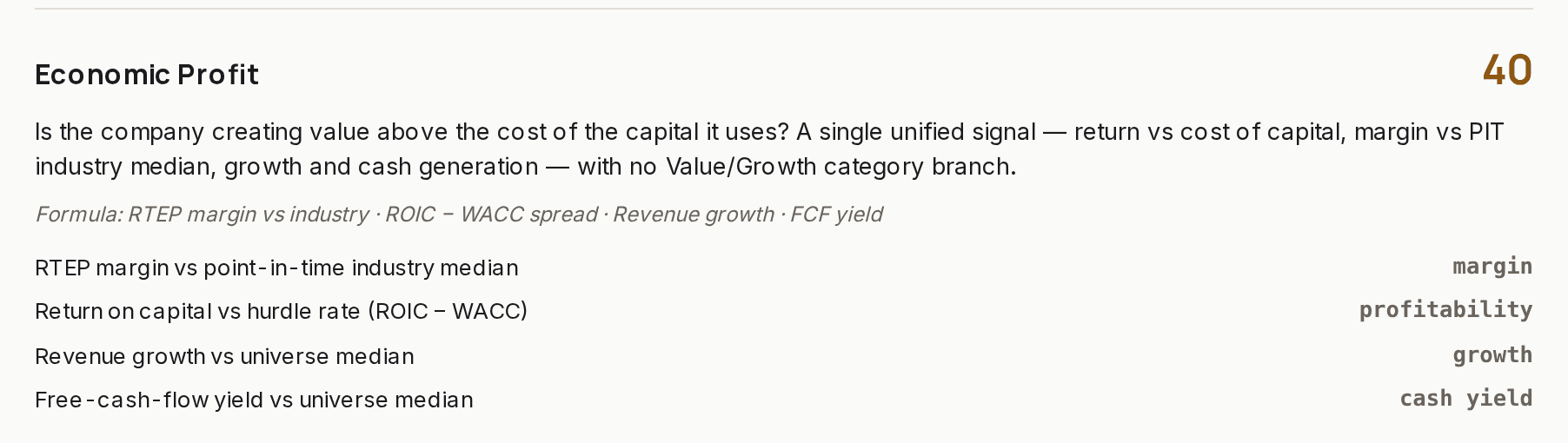
The result is a profitability number that moves when the business changes and sits still when only the accounting does.
What RTEP will not tell you
One year is one year. A company in the middle of a big build can show a weak RTEP for a while before the new capital starts earning. Read the trend, not a single bar.
Sectors differ. A regulated utility earns roughly what its regulator allows, so it will rarely clear its cost of capital by much. Compare a utility with other utilities first.
It is a measure, not a recommendation. A company with a strong RTEP can still be priced far above what it is worth. That is what the fair-value and margin of safety pillars are for.
On the page
Every one of these is visible to you
- Every company's RTEP margin, year by year
- Where each company's RTEP margin sits against its industry
- The return on capital and the cost of capital charged to each business
Kept internal
Named, so you know what you are not seeing
- How RTEP combines with the other pillars into the score
- The thresholds inside the Economic Profit pillar
Common questions
What is RTEP?
RTEP stands for Returnolio True Economic Profit. It asks whether a business earns anything after paying for every dollar of capital it uses, at what that capital actually costs it rather than at a house rate. A company earning 9% on capital that costs 11% is destroying value, and RTEP says so where a return-on-capital screen would not.
What is the difference between economic profit and net income?
Net income charges a company for the interest on its debt and nothing for its shareholders' money. Economic profit charges for both. Xcel Energy reported $2.0bn of net income in 2025 and minus $723m of economic profit, because the return on its capital was below what that capital cost.
Why does treating R&D as an asset matter?
Accounting rules expense research the year it is spent, which understates profit in heavy research years and leaves the research off the balance sheet. We book it as an asset and spread its cost over the years it pays off, so profit is not punished for building, and the research has to earn its cost of capital like any other investment.
Xcel Energy reported $2.0bn of profit in 2025 and still fell $723m short of what its capital cost. Profit is only profit after the capital is paid for.
Educational and proprietary. This explains what our research does, not the exact formula behind it, and it is not personalised investment advice. See the full disclaimer.
Was this page helpful?