

Which stocks we cover, and why the list is short
973 companies across 11 sectors and 24 countries, most of them listed in the US. What gets a company in, what takes it out, and why we cover a fraction of one percent of the world's listed companies on purpose.
Last updated September 3, 2026
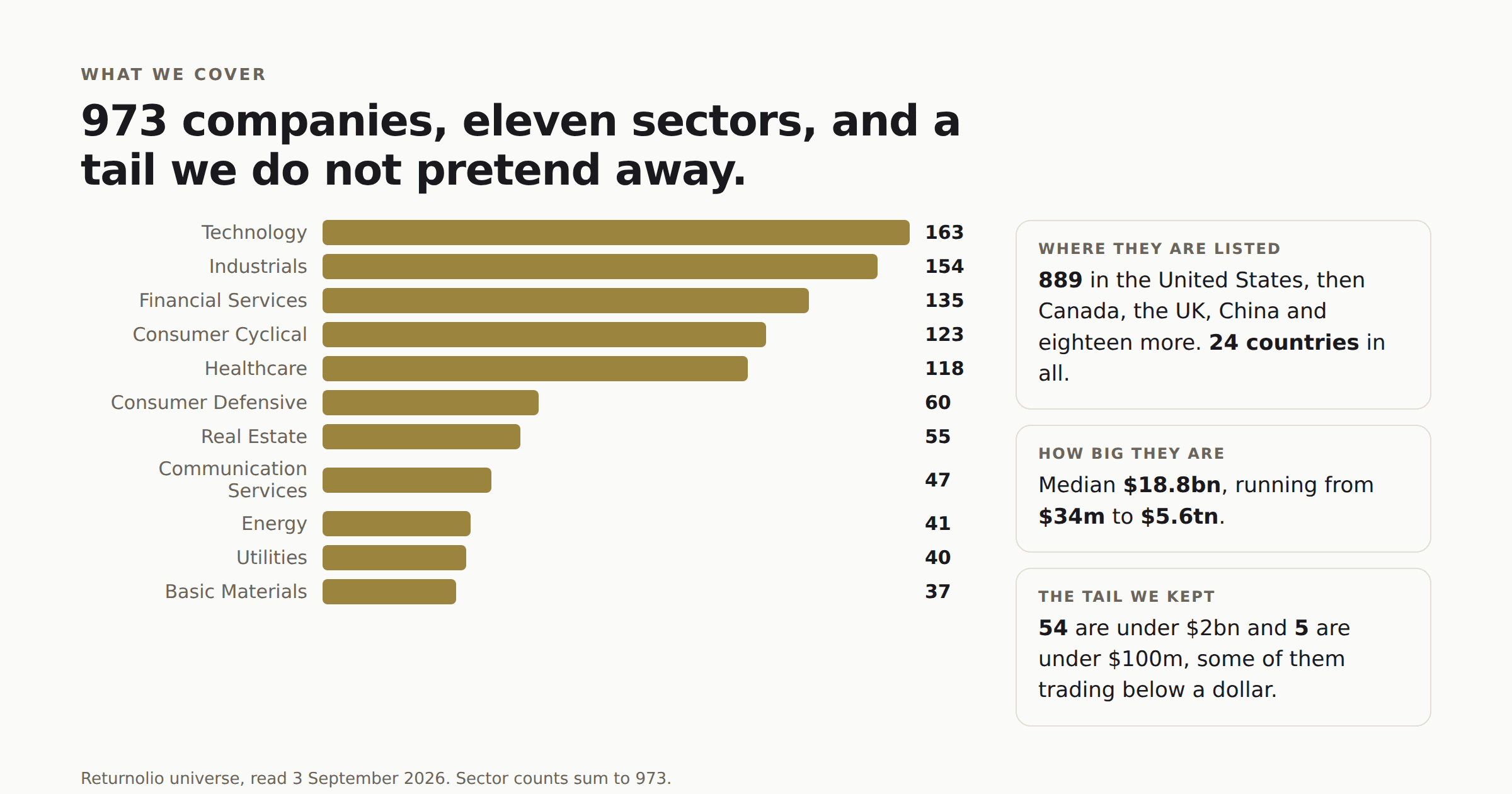
The universe is 973 companies across 11 sectors and 24 countries. The large majority are US listed, with the rest spread across Canada, the UK, Europe and Asia. The exact count moves as companies enter and leave; the screener always shows the current number at the top of the table.
There are tens of thousands of listed companies in the world. We cover a fraction of one percent of them on purpose.
Why the list is short
A ranking is only meaningful if every company in it has been measured the same way. Rank a class where half the students sat a different exam, and the order tells you nothing. Measuring the same way requires a consistent run of filings, a share count you can trust, a price history long enough to be worth something, and enough disclosure to compute the same metrics for every name.
Plenty of listed companies do not clear that bar. Some are too small or too thinly traded, with too few shares changing hands each day, for the numbers to mean anything. Some do not disclose enough. Others are recent listings without the history a score needs.
Including them would make the universe bigger and every ranking in it worse.
Absence is not a verdict
A company missing from Returnolio has not been assessed and rejected. It has not been assessed. Read an absent ticker as "we do not cover this", never as "this is a bad company".
What is in and what is not
The universe is weighted toward established, profitable, liquid companies of the kind a long-term investor might actually hold for years. The median company is worth about $18.8bn, and the range runs from tens of millions up to the largest companies in the world.
As a rule you will not find pre-revenue listings (companies with no sales yet), shell companies, or the very small and very hard-to-trade end of the market. That is not a judgment about whether money can be made there. It is that the methodology has nothing useful to say about a company with no earnings history to measure.
There is a real exception, and it is easier to write it down than to let you find it. The list carries a legacy tail from the years when it was assembled by hand: on 3 September 2026, 54 companies were worth less than $2bn, five were worth less than $100m, and a handful trade below a dollar a share. The smallest is around $34m. They are being kept for now rather than dropped in one go, because removing names from a universe changes every historical comparison that runs across it, and that is a decision worth making deliberately rather than quietly.
Read them for what they are. A score on a company that trades a few tens of thousands of dollars a day is measuring the filings accurately and telling you very little about whether you could act on it.
Some categories are covered but held out of the Top 10 specifically, because the model's valuation approach does not translate cleanly to how they are structured. They keep their pages and their scores.
How the list changes
Companies enter as they grow into the criteria and leave when they are acquired, delisted, or renamed. Renames and mergers are the fiddly case: a ticker can change hands entirely, and treating the new company as a continuation of the old one would corrupt its history. Changes like these are reviewed rather than applied automatically.
Coverage within a company page
Not every section is populated for every company. Segment breakdowns depend on how a company chooses to report, guidance depends on whether it issues any, and earnings call material depends on whether the call is published openly.
Where we have nothing, the section says so. It does not fill the space with a plausible-looking estimate.
Educational and proprietary. This explains what our research does, not the exact formula behind it, and it is not personalised investment advice. See the full disclaimer.
Was this page helpful?