

Stock analysis · · 7 min read
The air-conditioning company that went up 27 times, and the sentence that moved first
Comfort Systems USA (FIX) went from $57 to $1,574 in under six years, fitting cooling for data centres. What the 27x is made of (a 7x business at a 4x price), the one sentence in the annual report that moved first, and why the usual screeners do not show it.
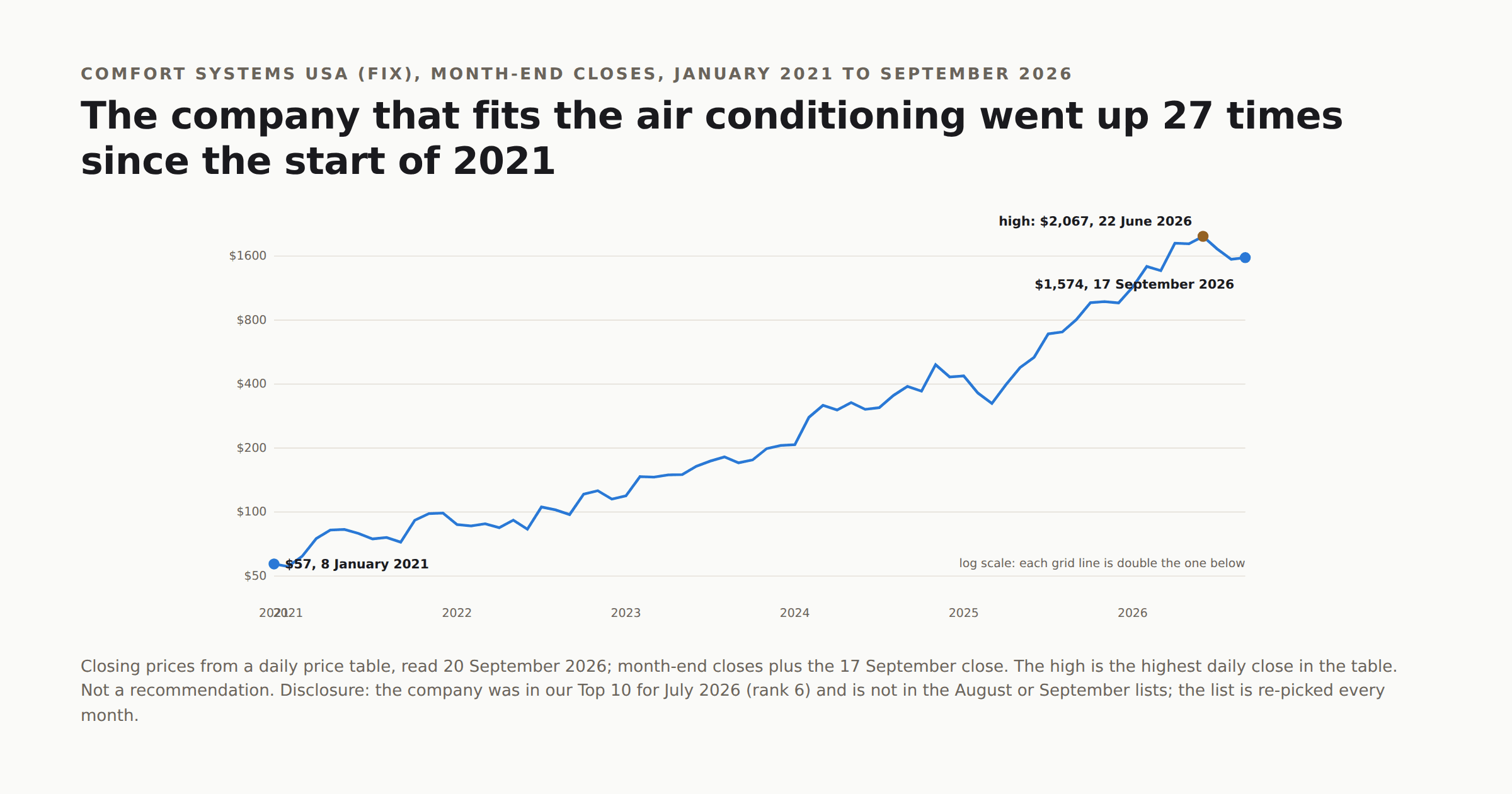
The best stock since the start of 2021 that I know of does not make chips, write software or train a model. It installs air conditioning. Comfort Systems USA, ticker FIX, Houston, about 22,700 people, fits and services the cooling, pipework and electrics in commercial buildings. $57 on 8 January 2021. $1,574 on 17 September 2026. Twenty-seven and a half times.
I did not own it at $57. Almost nobody did, and the ones who say they did mostly mean they bought at $400 and are rounding. What I want to do instead is the useful thing: take the chart apart and show you what it was made of, and which number in the filings moved first. Because the chart is over. The habit is not.
Why a plumber
A data centre is a heat problem with computers attached. Every watt the chips draw comes out as heat, and somebody has to design, fit and maintain the machinery that carries it away, plus the pipes and the electrics that feed the whole thing. That is not Nvidia's job. It is a contractor's job, and Comfort Systems is a contractor that does it, at the scale of $3 billion of work a quarter.
In the quarter to June 2026 the company told the SEC that demand was "especially strong in the technology sector, particularly for data centers". Technology customers were 58.7% of revenue, up from 43.0% a year earlier. Quarterly revenue was $3.27 billion against $2.17 billion a year before, up 51%. Earnings per share $12.53 against $6.53, up 92%. Cash from operations in the quarter, $1.14 billion. Those are from the 10-Q and the results release of 23 July 2026, and they are the most recent full set.
For scale: the middle company of the 966 we cover saw its share price rise 0.5% in the year to 17 September. Comfort Systems grew its quarterly revenue by half.
The sentence that moved first
Every annual report has a line about backlog: work that customers have signed for and the company has not yet done. It is one sentence, once a year, in the 10-K, and here is Comfort Systems' at each year end:
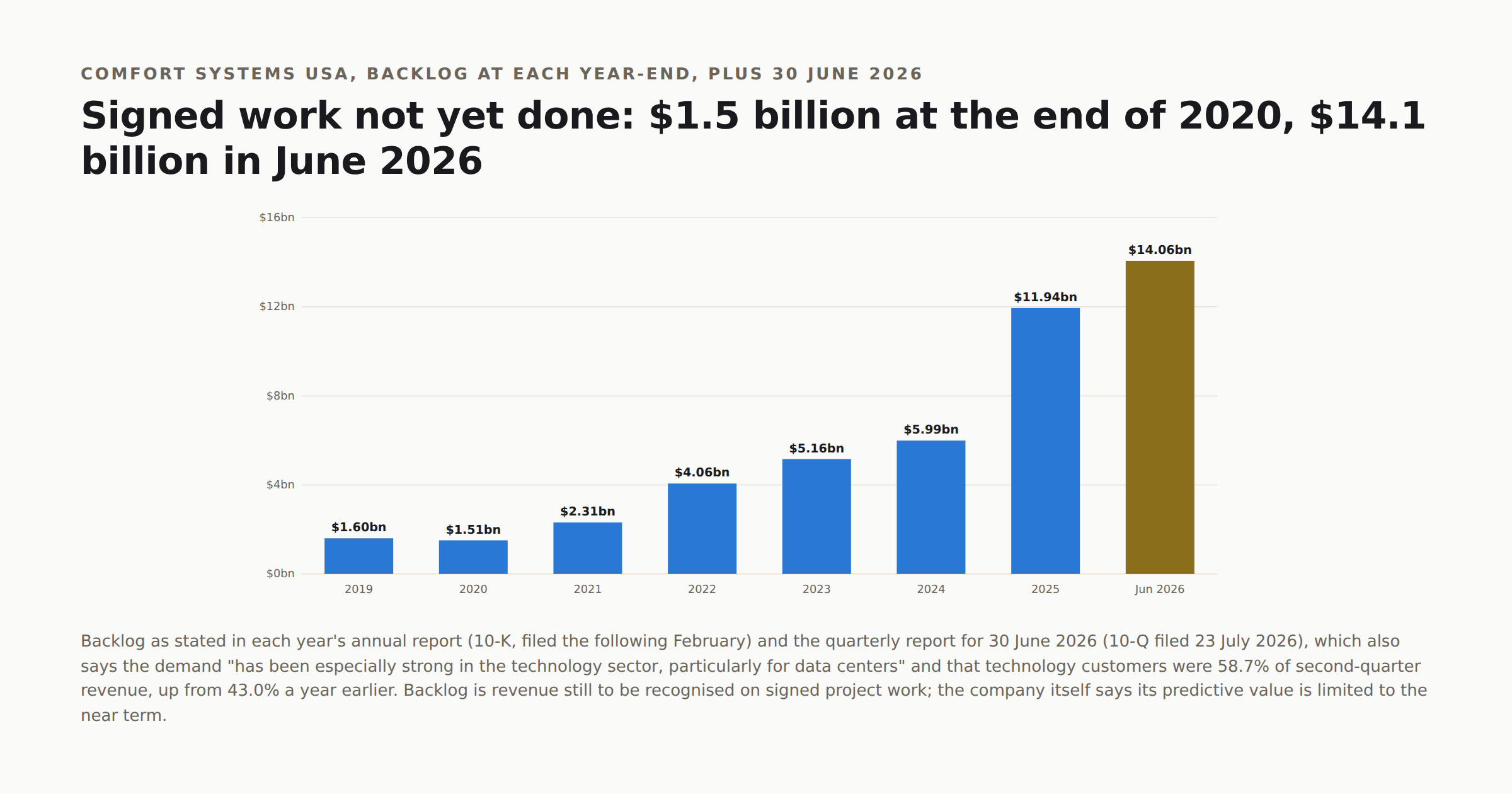
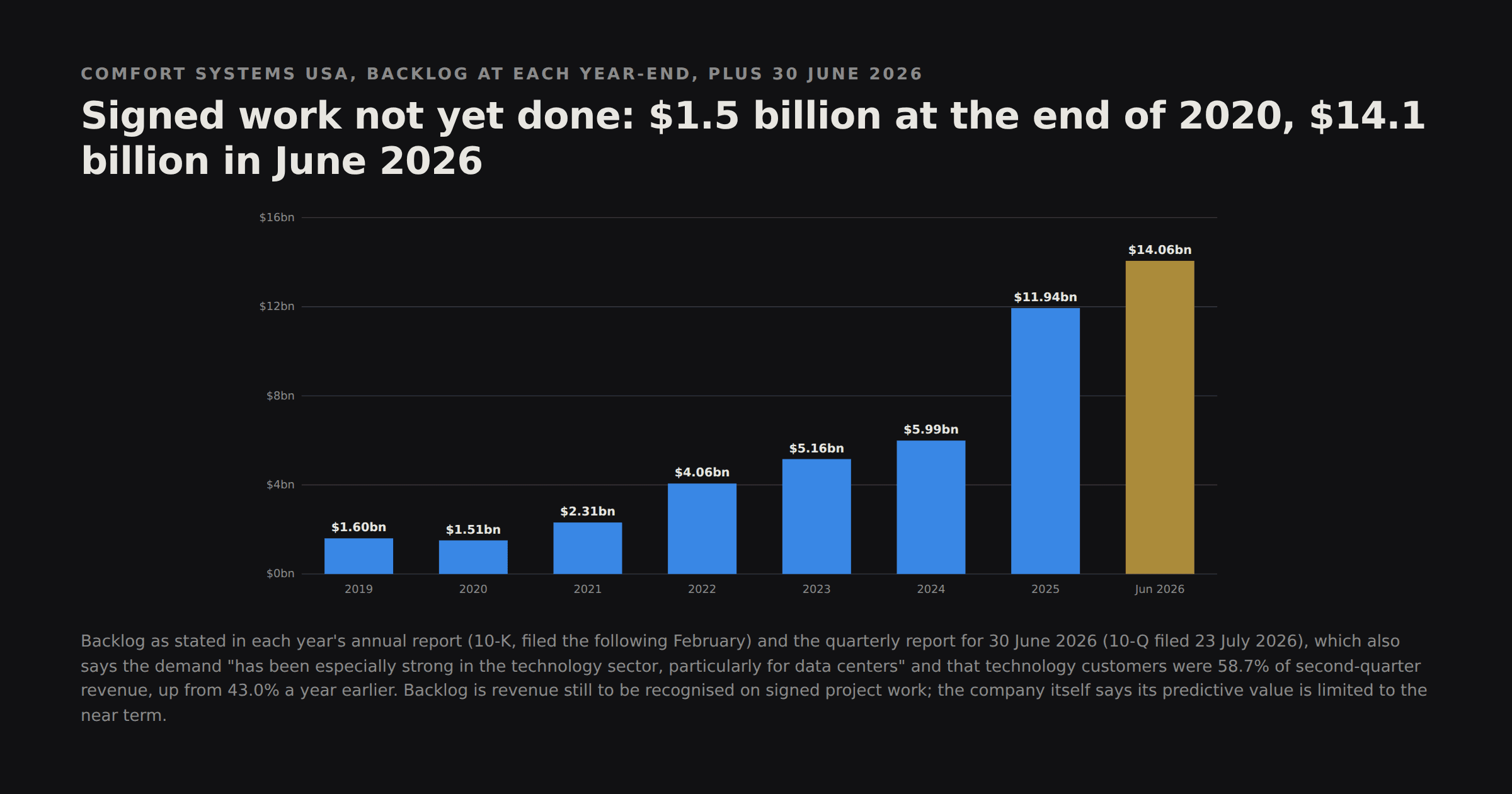
$1.5 billion at the end of 2020. $2.3 billion a year later. Then $4.1, $5.2, $6.0, $11.9 billion, and $14.1 billion at the end of June 2026. Nine times in five and a half years.
Look at the second bar. The 2021 annual report, filed on 23 February 2022, showed backlog up 53% in a year. The shares that week were about $86. You did not need to predict artificial intelligence or know what a GPU was. You needed to read one sentence, once a year, and notice it had grown by half. Then read it again the next February and notice it had nearly doubled.
Here is the uncomfortable part. Backlog is not a column on the screeners most people use. Price, P/E, revenue growth, dividend yield, yes. The one number that told you about this company at $86, two years before it reached $279 in February 2024, sits in a paragraph of text, and you have to open the filing to find it. That is not a complaint about screeners. It is the whole reason to open the filing.
What the 27x is made of
This is the part I wish someone had told me before I ever chased a chart. A share price is two numbers multiplied: what the company earns per share, and what people will pay for each dollar of that. When a stock goes up 27 times, both moved, and it matters enormously which one moved more.
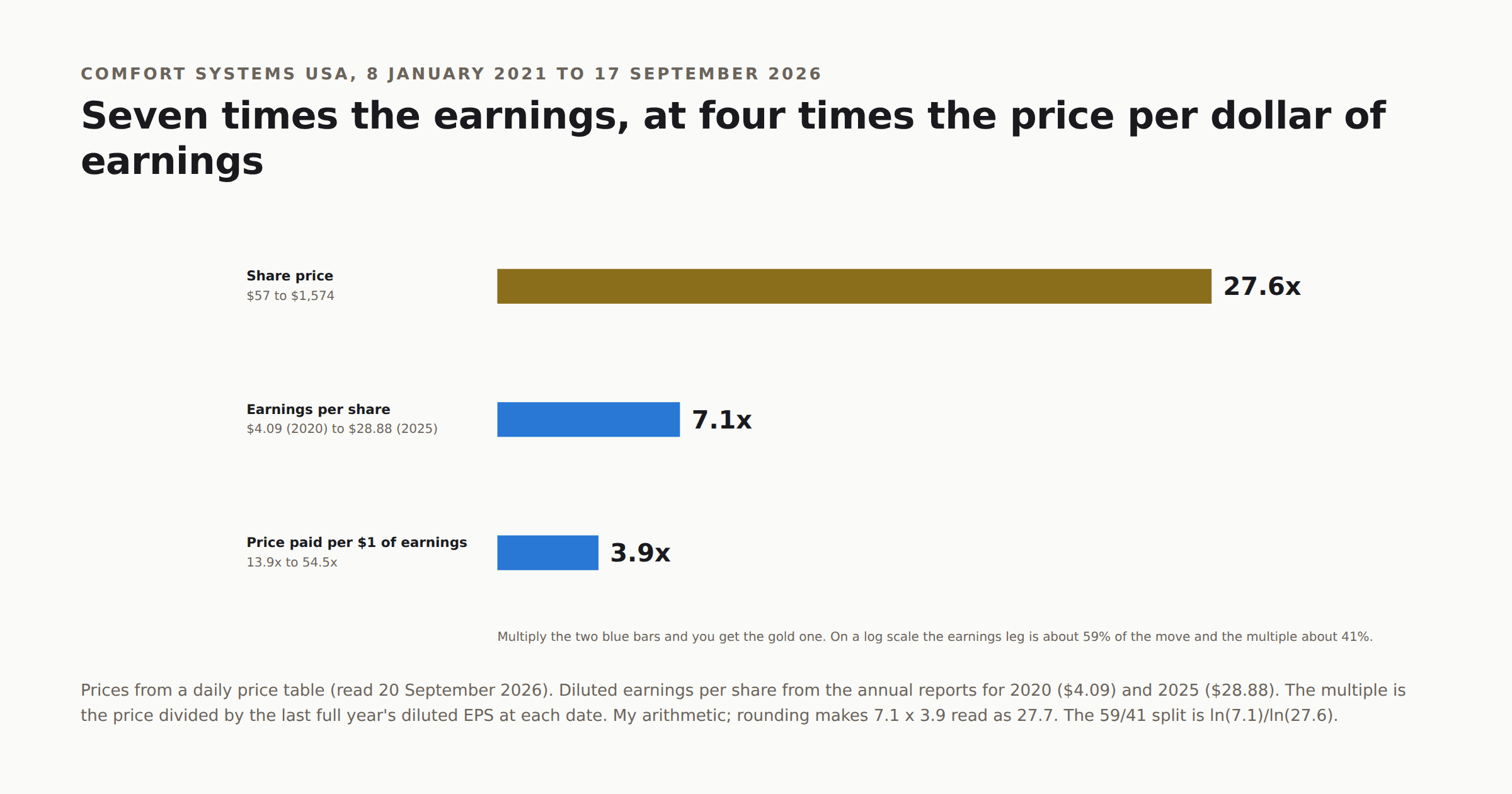
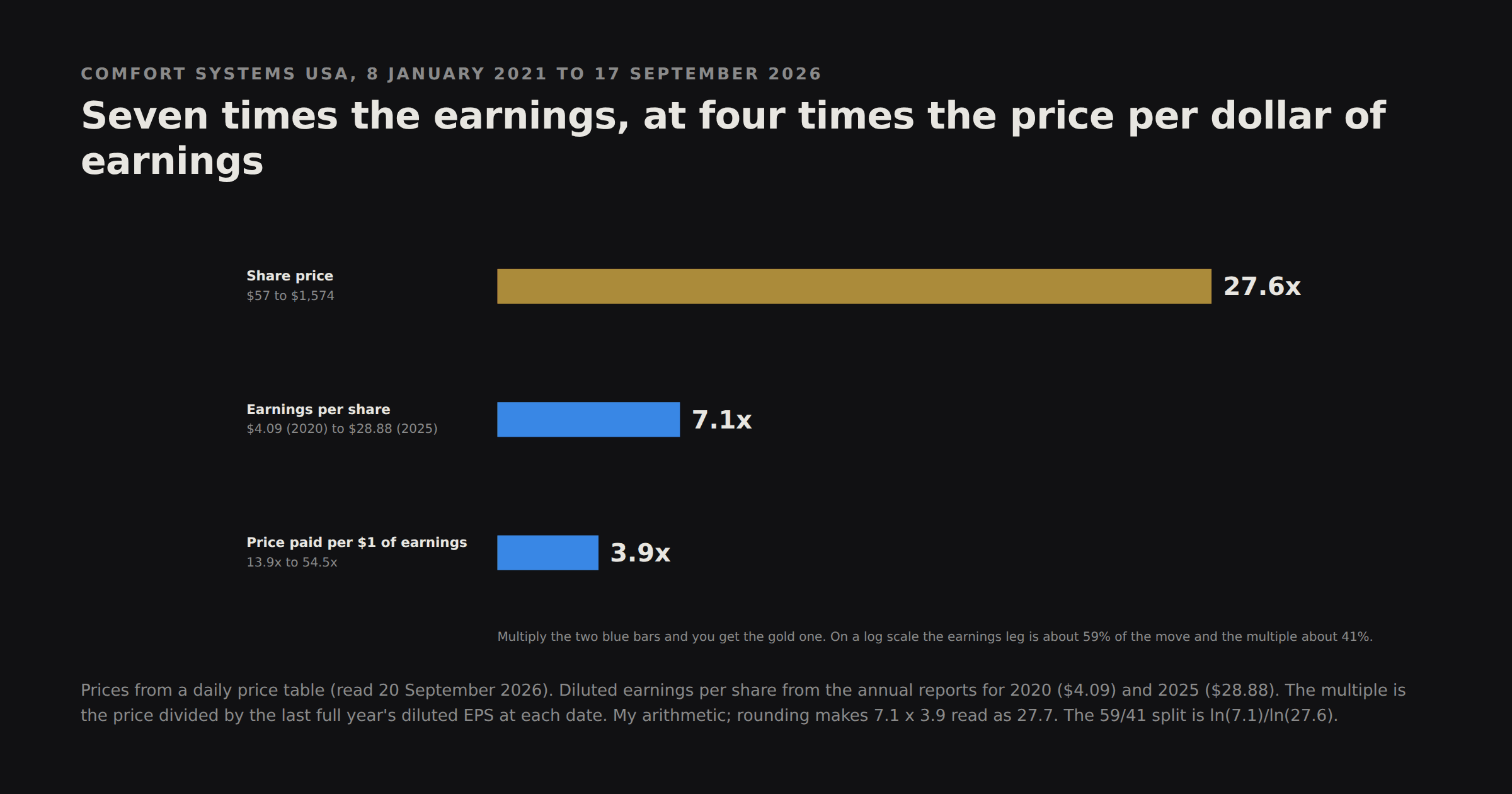
Earnings per share went from $4.09 in 2020 to $28.88 in 2025. Seven times. That is the business: more work, done at better margins, with the diluted share count going from 36.7 million to 35.4 million. It is filed and audited.
The price paid for each dollar of those earnings went from 13.9 times to 54.5 times. Four times. That is not the business. That is a crowd deciding that a contractor deserves to be priced like a software company, which it did not think in 2021 and does think now.
On a log scale, the earnings leg is about 59% of the move and the re-rating about 41%. So more than half of the 27x is real and banked. A bit under half is a mood, and here is what a mood does: it can go back to 14 times without a single bad quarter. If earnings never fell and the multiple simply went home, the shares would be worth about a quarter of what they are. Nothing about the plumbing would have changed.
That is where the risk in this stock sits. Not in the data centres, not in the backlog, but in the 54.5.
(One footnote for the careful: our company card shows a P/E of about 32, not 54, because it uses the last four quarters, and the quarters since December have been far bigger than 2025's average. That gap is growth already banked. On either basis the 13.9 in 2021 is the same, and so is the lesson.)
What happened since June
The shares peaked at $2,067 on 22 June 2026. On 17 September they were $1,574, 24% lower, with earnings still rising. That is the multiple doing a small version of what I just described. The results on 23 July showed revenue up 51% and earnings per share up 92%; the stock went down anyway, because the price had already assumed something even better.
On 22 June, the same day as the peak, the company announced a new chief operating officer, Craig Sasser, from 1 July; Brian Lane stays chief executive and William George chief financial officer, both signing the 10-Q on 23 July. I mention it because officer changes are the kind of thing a reader of filings notices and a reader of charts does not, and because a company growing this fast needs the bench.
Two things it shows
I own the companies on our monthly list of ten, and Comfort Systems was on that list in July 2026 and has not been on it in August or September; the list is re-picked every month from the numbers.
Beyond that, it is the cleanest example I know of two things. First: the number that moves first is often a sentence, not a column. Second: a 27x stock is a 7x business at a 4x price, and you should always know which of the two you are buying, because only one of them is yours to keep.
Doing this on the next one
The routine, for any company whose chart makes you feel late:
- Split the move. Price then and now; earnings per share then and now; divide. The business leg is what happened. The multiple leg is what people now believe.
- Find the sentence. For contractors, backlog. For software, remaining performance obligations. For retailers, same-store sales. Every industry has one line the chart lags, and it is in the 10-K, not in the screener.
- Read it for three years running. One good year is a contract. Three is a business.
- Ask what the multiple assumes. At 54 times earnings, the market has already paid for years of growth. Your return comes from the years after those, or from the crowd getting even more excited, and only one of those is investing.
Every company page in our app shows step 1's inputs by year and draws the split against the company's own history and its industry; the Comfort Systems page is where the 32x and the 54x above come from, and the free report on any company shows you the same page. Step 2 is still you and the filing. That part is the job.
Educational and proprietary. This explains what our research does, not the exact formula behind it, and it is not personalised investment advice. See the full disclaimer.
Read next

7 min read
A low P/E is not a discount. It is a forecast, and often a correct one
Screen for the cheapest companies and you get businesses the market expects to earn less next year. What breaks when the multiple is your only filter.

10 min read
The price target says buy. The valuation says wait.
An analyst price target and a fair-value estimate answer different questions. Nike's targets from 2022 to 2026, month by month, show why one moved with the price and the other did not.

8 min read
How to read a balance sheet, on one real filing
A balance sheet in one hour, using a real one: Home Depot's 10-K for the year to 1 February 2026. What each line means, which four numbers matter, and why a $105 billion company owns $13 billion on paper.