
Markets · · 9 min read
Bumble's $6.05 cash buyout with no shareholder vote: what holders get
Bumble is being bought for $6.05 a share in cash, 138% above the unaffected price, and the big holders already signed. What you get and what still has to happen.
Bumble sold its first public shares at $43 in February 2021. On 13 October 2026 it announced it will leave the stock market for $6.05 a share, in cash.
If you own the stock, that number has just become the only one that matters. Not next year's paying users, not the new app design. The question now is whether the deal closes, and when the money lands. I read the filing so you don't have to, and here is what it says.
The deal in one paragraph
On 12 October 2026 Bumble signed a merger agreement (the contract that sets out how one company swallows another) with Ithaca Holdco, Inc., part of Ithaca Holdings, a holding company for technology businesses run by its co-founders Ravi Gupta and John Hegeman. Each Class A share, the kind you can buy in a brokerage account, will be turned into $6.05 in cash, without interest. The press release values the whole company at $1.3 billion. Bumble then becomes a private company: no ticker, no quarterly reports, no share price.
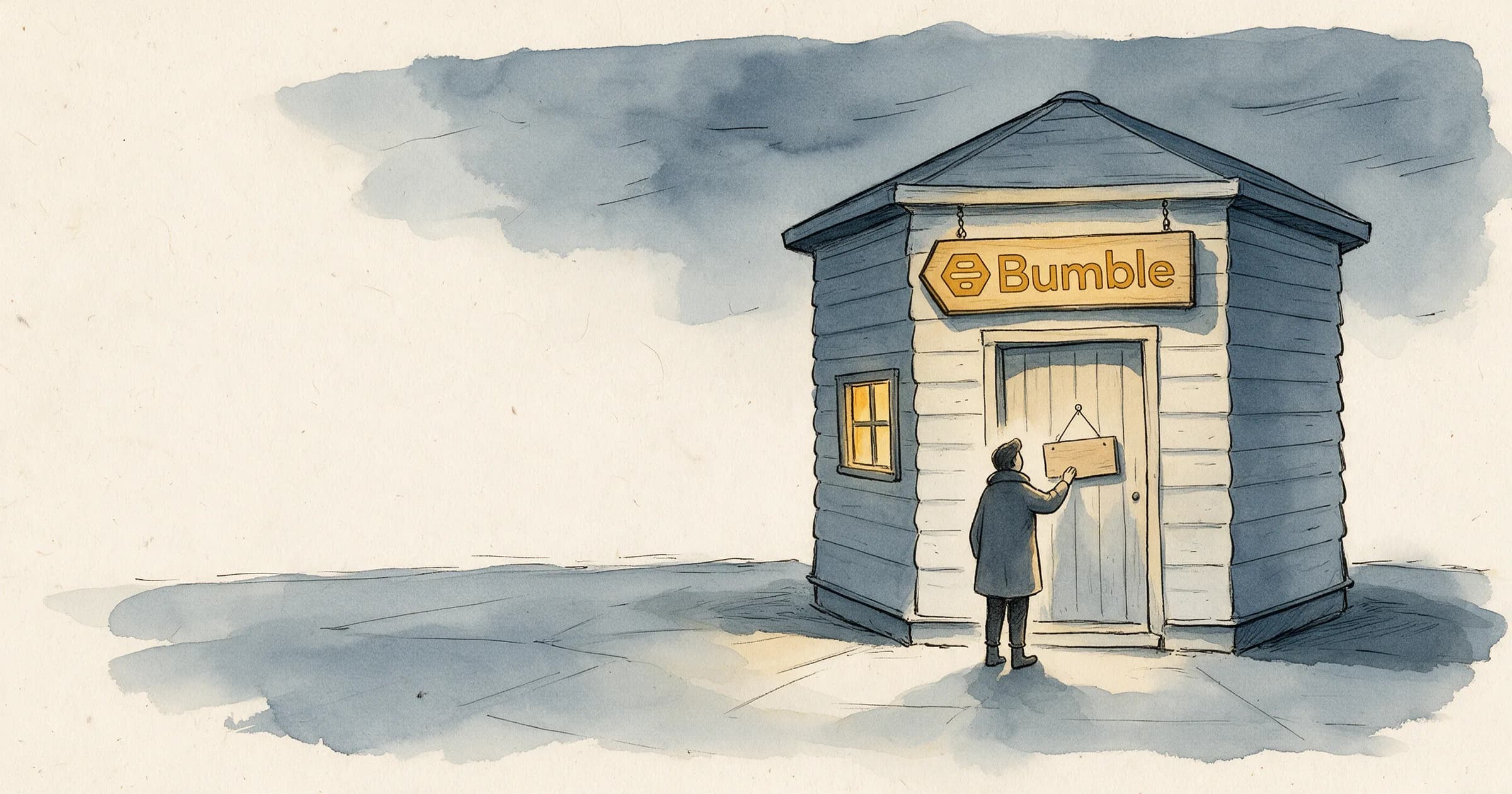
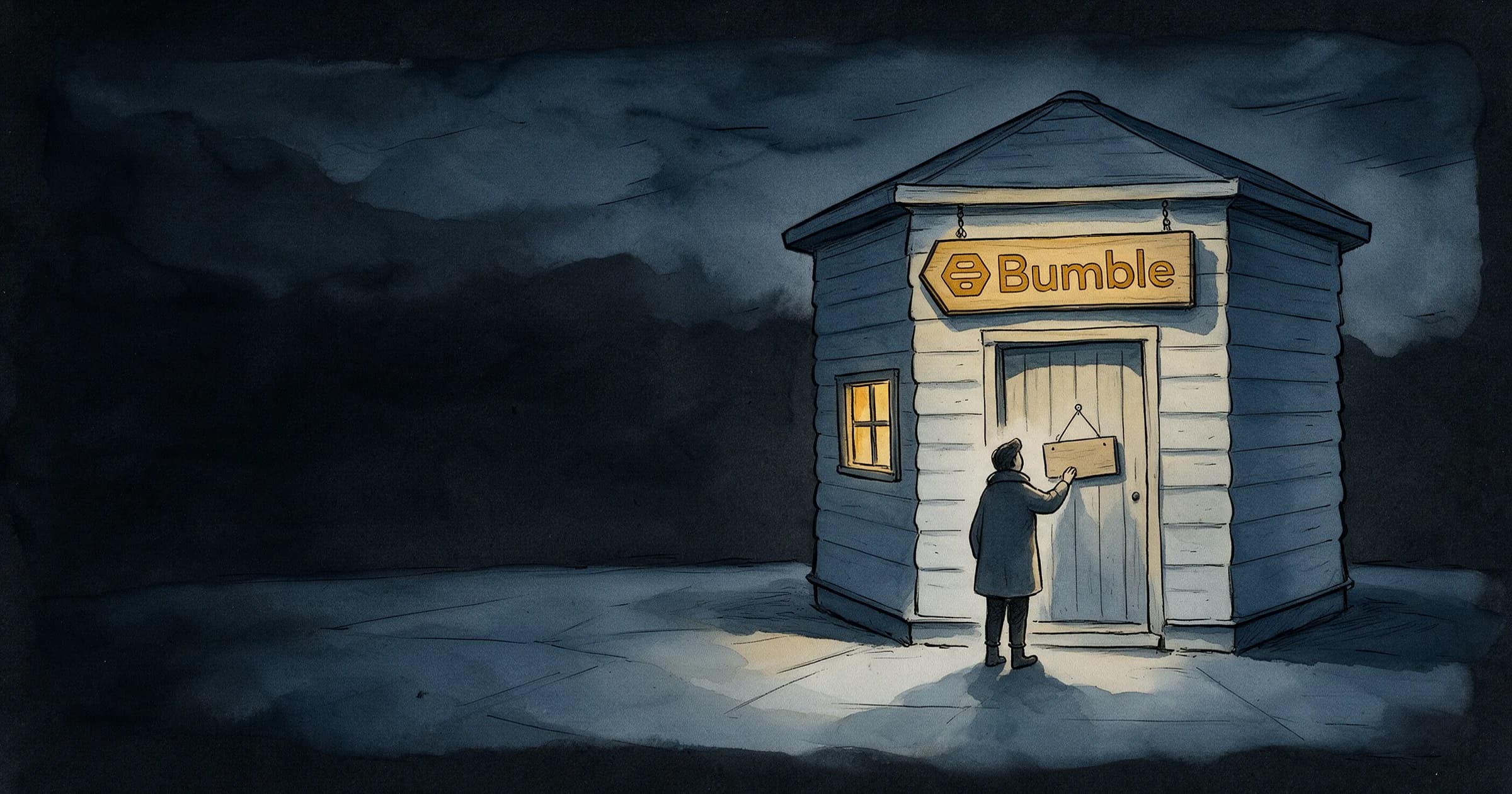
This is called a take-private. Think of a family selling the corner shop to a buyer who will keep the name over the door but stop publishing the accounts in the window.
Is $6.05 a good price?
Compared with where the stock was, it is a big jump. Bumble closed at $2.54 on Friday 9 October. The press release calls that the "unaffected" price, meaning the last close before talk of a deal could move it. $6.05 is about 138% above it, so more than double. Against the average price of the 30 days to 9 October, weighted by how many shares traded each day, the premium is about 119%.
The talk did leak. On Monday 12 October, before anything was announced, the stock closed at $3.80, up about half in a day, after The Wall Street Journal and Reuters reported that Bumble was in advanced talks to go private. That is why the press release measures the premium from the Friday close.
Compared with where Bumble started, it is a different story. $6.05 is about 86% below the $43 IPO price. Anyone who bought on day one and held is getting back roughly one dollar in seven. The buyout does not change that; it just makes it final.
You don't get a vote. It already happened.
This is the part that surprises people. Right after signing, the principal stockholders (named in the press release as affiliates of Blackstone, the private equity firm, and founder and CEO Whitney Wolfe Herd) signed a written consent adopting the agreement. A written consent is how holders with enough votes approve something on paper, without calling a meeting. The filing says no further action by shareholders is required.
So if you were planning to cast the dramatic deciding vote, I have bad news. The ballot box was put away before the hall was booked.
The process ran through a special committee of independent directors, chaired by board chair Ann Mather. It recommended the deal and the full board approved it unanimously. Ms. Wolfe Herd stepped out of the board's discussion and vote.
She is also not simply cashing out. Under a rollover agreement, Beehive Holdings III, LP, an entity tied to her, will hand Class A shares to Oak Topco, Inc., an Ithaca company, in exchange for a stake in it. Those shares do not get the $6.05. After closing, Ravi Gupta and John Hegeman become co-CEOs of Bumble, and Ms. Wolfe Herd says she will remain actively involved. Bumble is expected to stay based in Austin.
What each kind of holding turns into
From the 8-K, the short report a company must file with the SEC when something big happens:
- Class A shares: $6.05 each in cash. Excluded are the rolled-over shares and shares of holders who formally dissent and ask a Delaware court to set the value instead.
- Class B shares: $0.000001 each. Yes, a ten-thousandth of a cent.
- Common units in Buzz Holdings L.P., the partnership underneath Bumble: $6.05 minus that ten-thousandth of a cent.
- Stock options: cancelled for nothing, vested or not. If you work at Bumble, read this line twice.
- Restricted stock units (shares promised to staff that arrive over time): units already vested, units that vest because of the deal, and units held by outside directors or Ms. Wolfe Herd become $6.05 each in cash. Unvested units become a promise of the same cash, paid on the original schedule as long as the holder stays.
- Incentive units in the partnership: forfeited for nothing.
- Employee stock purchase plan: no new purchase periods, and the plan ends at closing.
If you hold Bumble through an index or sector fund, the same thing happens one level up: the fund's shares become cash and the fund deals with it under its own rules.
What still has to happen before the cash arrives
Shareholder approval is done. The rest of the list, from the 8-K:
- US antitrust clearance. The Hart-Scott-Rodino waiting period, a window in which regulators can look at a deal of this size before it closes, must expire or end. Some other government approvals are also needed.
- An information statement. Shareholders who got no vote still get a document explaining the deal. It has to be mailed, and then 20 days must pass.
- No "material adverse effect." Legal shorthand for something going badly wrong with the business before closing, which would let Ithaca walk.
Money is not on the list. The agreement has no financing condition, so Ithaca cannot point to a lack of money as a reason not to close. If it fails to close when it is required to, the $102 million fee below is what it owes. Greenoaks Prime Radiant LP has signed an equity commitment letter, a written promise to put money into the buyer.
There is also a deadline. Either side can end the agreement if the deal has not closed by 12 July 2027. That is the outer wall, not a target date.
What happens if it falls apart
Break fees are payments one side owes the other if the deal dies in certain ways. Here they are lopsided, and that is the useful part.
- Bumble would owe Ithaca $29 million in specific cases, including if the deal ends after a rival offer has gone public and Bumble then agrees a deal with someone else within 12 months. That is about 2% of the $1.3 billion price.
- Ithaca would owe Bumble $102 million in specific cases, such as failing to close when it is required to, or a serious breach it does not fix. That is about 8% of the price, three and a half times Bumble's fee.
Ithaca has to put its $102 million into escrow (money parked with a neutral third party so it cannot be spent) by 19 October 2026. Picture a buyer leaving a large deposit with the estate agent before the keys change hands. It is not a guarantee, but it makes walking away expensive.
The contract makes a rival bid harder to land. Bumble agreed to a "no-shop" clause, a promise not to go looking for other buyers. Before the written consent, the clause let Bumble talk to an unsolicited better bid in certain cases. The consent has been delivered, and that door was tied to it.
The gap between the share price and $6.05
On 13 October, the day of the announcement, Bumble closed at $5.95. That is 10 cents, or about 1.7%, below the $6.05 a holder would get at closing.
That gap is the market's price for two things: waiting months for the cash, and the small chance the deal breaks and the stock falls back toward where it was. It works like a gift card that only becomes cash on a later date: people pay a little less than face value for it, for the wait and for the small chance the shop never opens. A small gap says the market expects the deal to close. A gap that suddenly widens usually means the news has changed.
Where the business stood before the deal
The last quarter Bumble reported before signing, from its 10-Q (the quarterly report filed with the SEC), next to the same quarter a year earlier:
| Quarter ended 30 June | 2026 | 2025 |
|---|---|---|
| Revenue | $210.5 million | $248.2 million |
| Total paying users (monthly average) | 3.16 million | 3.78 million |
| Impairment charge | $169.3 million | $404.9 million |
| Operating loss | $112.0 million | $338.3 million |
| Net loss attributable to Bumble Inc. | $110.1 million | $253.7 million |
Revenue fell 15.2%, by $37.7 million. Paying users fell a little faster, 16.4%. That is the business shrinking at the top.
The big losses need a footnote, because most of them are not cash. An impairment charge is an accounting write-down: the company admits something it bought, here mostly goodwill (the premium it once paid above the value of the assets it acquired), is worth less than the books say. Bumble took one in both quarters. The 2026 charge was triggered, the 10-Q says, by the sustained fall in its own share price. Add the write-downs back and the business made about $57 million from operations in the quarter, against about $67 million a year earlier. Smaller, but not on fire.
That is the company Ithaca is buying: still earning from operations, losing paying users, and priced by the market at $2.54 a share the Friday before the deal. If you want to see how we lay out a company's numbers over many quarters, our sample report shows a full one.
What to watch next
From here the news arrives as filings and dates.
- 19 October 2026: the $102 million escrow deposit is due.
- The information statement: once it is mailed, the 20-day clock starts. Its mailing date is one of the two markers to watch; the other is antitrust clearance.
- The Schedule 13E-3: a going-private statement Bumble, Ithaca and others must file. It is where the background of the deal and the committee's reasoning usually appear in detail.
- By 9 November 2026: the third-quarter 10-Q. Because of the deal there will be no earnings release and no conference call, so the filing is all you get.
- Antitrust clearance: a filing or announcement that the waiting period has ended.
- 12 July 2027: the date either side can walk away if it has not closed.
As of 14 October I found no competing bid, no amended terms and no filed lawsuit. Two shareholder law firms, Ademi LLP and Bleichmar Fonti & Auld, have put out press releases saying they are looking into whether the price is fair.
In short: the price is set, the vote is done, and the buyer has a lot to lose by not showing up. What is left for a holder is to follow the filings until the cash arrives.
Sources: Bumble Form 8-K filed 2026-10-13, Item 1.01 and Exhibit 99.1, joint press release, read 2026-10-14; Bumble Form 10-Q for the quarter ended 2026-06-30, filed 2026-08-06; Bumble IPO prospectus (424B4), filed 2021-02-12. Closing prices for 9, 12 and 13 October 2026: Returnolio market data, read 2026-10-14. Reuters, "Bumble in advanced talks to go private at $1 billion valuation, source says", 2026-10-12, read 2026-10-14. Law firm releases: Ademi LLP and Bleichmar Fonti & Auld, read 2026-10-14. Changes, percentages and the operating figures before write-downs are my arithmetic on those figures.
Educational and proprietary. This explains what our research does, not the exact formula behind it, and it is not personalised investment advice. See the full disclaimer.
Read next
8 min read
How to read financial statements in an hour, on McDonald's
The three statements every listed company files, read in twenty minutes each on McDonald's 2025 annual report: an income statement that shows it is a landlord, a balance sheet with less than nothing left for the owners, and a cash flow statement that explains why that is fine.

9 min read
How to read an earnings report in 15 minutes, on Coca-Cola
An earnings report in 15 minutes, on a real one: Coca-Cola's second quarter of 2026. The six places to look, in order, and the four traps, including an adjusted profit lower than the official one.
10 min read
Morgan Stanley Q3 2026 earnings: a record $232 billion of new money, margins a little thinner
Morgan Stanley grew Q3 2026 revenue and earnings per share, but margins slipped. What the quarter means if you own the stock or a fund that holds it.